Wednesday, 28 December, 1988
Firenze [Florence]
Tired, so I slept till nearly 10:00. Got up, hit a pastry shop/snack bar for some breakfast (Italian pastries aren’t as good as French ones) then a bank for some Italian currency for some traveller’s cheques.
Then, since my main personal reason for coming to Firenze (apart from the external feeling that I "ought" to see it) was to do a bit of shopping, I hit the open market.
After about three hours of wandering up and down the Via dell’Ariento I came away with a brown leather belt for 15,000 lire (the man put a different buckle on for me), some four-button-length silk-lined black leather gloves for around 22,000 lire (to replace the pair I lost the left hand to in Lyon), a dark wine red leather dress purse for 35,000 lire, and a large (120 cm square) wool navy, gray, and red scarf for 27,000 lire.†
The young man who sold me that might be going to Philadelphia in the next year-- to study at Wharton. Ye gods. That’s where Mort Levi* [one of our best architecture clients back in the States] went. He’s not sure he wants to leave his friends and family, though, since he feels that if he goes to America he goes for good.
This city is funny for the language. I’ll be struggling along in Italian and the Florentine will inform me he or she speaks English-- and so they do, often better than I.
Bought some dates and some black olives in the adjacent covered market. Interesting thing about that place. I’ve seen nudie posters in machine shops and car repair garages, but I’d never thought to see a picture of an all but naked woman hung up as an inducement to buy vegetables. Maybe I’m silly but I gave such stands no consideration.
My shopping accomplished, I went over to the Duomo and went inside. Very much a tourist church, though some people were managing to pray in a side chapel or two.
Paid the fee to go up Brunelleschi’s dome. The inside of it was covered with the omnipresent scaffolding so I have no idea how it’s supposed to look from the floor of the cathedral. But you can go up to a gallery around the springing point and then on up over the dome itself (someone had chalked on the upper surface of the inner dome, in English, "BRUNELLESCHI IS GOD") then up and outside onto a deck around the cupola.
Damned shame it was so blasted foggy today. The view must be magnificent when it’s clear.
I’d gone through most of my Italian currency at the markets and I still had to pay the hotel for tonight. So I went back, paid the lady, dropped off my purchases, and got more traveller’s cheques out of the money belt. Changed those at a different bank than before. Better exchange rate at the second. Oh well! Bought a very good hot proscuitto ham and mushroom sandwich at a snack bar and ate it on the way there.
Went by Santa Maria Novello to look at the façade but didn’t go in. Headed down to the Arno to look at the river from the Ponte S. Trinita. Ponte Vecchio to the east there, all lined with shops. Went and half-crossed it as well. This place is unbelievable like Toulouse and Paris. Jewelry and fashion and other high priced shops all crammed in one after another. Who buys all this stuff?
The Piazza Signoria next. And the woman at the lecture last night was right (not the Canadian I spoke to, but another Toronto native who either works for or lives with or is married to-- or all three!-- Mr. von Durer)-- the place is dripping with scaffolding. You can just see Cellini’s Perseus standing above it in the southern arcade. Nevertheless, this was the artistic reason I’d come to Firenze. Berlioz stood here, about where I was standing, and saw that statue. He was inspired by it and by the memoirs of its sculptor to compose his opera Benevenuto Cellini. He saw all this, that I was seeing (sans scaffolding), and he gazed on these very buildings and sculptures-- oh God!
OK, then, time to go home!
No, at least one museum had to be done and I chose the Uffizi. Saw everything there (that wasn’t being cleaned). I love the way they can afford to let all these Roman copies of Greek sculptures just sit out unlabelled in a dimly-lit corridor. Hell, they’ve got more where those came from.
When I was still in the early period galleries a girl came up and asked me if I spoke English. I said yes and she said, "Are you Blogwen*-- I forget your last name." I looked and it was Melissa* from the program in Oxford. Well.
We stood and talked for awhile. She’s travelling with Lucy*, another of the OOSC people, and is heading for Greece tonight. She, too, was in Paris the 18th and saw Darrell* and Harriet* [two more of our Oxford American contingent and fellow-lodgers at Coverdale College*] at the Louvre. They were looking for the Impressionist paintings . . . †† And if I think I’ve been having problems with French, they were really in difficulties. Melissa told me they knew none at all.
It was nice to see a familiar face like that. Very encouraging.
She'd been at the Uffizi for awhile already and was getting ready to leave. Me, I still had a lot to see. And so, dutifully, I did. I know it’s blasphemy to say it but, on this trip at least, I find myself unmoved by great paintings per se. Oh, it was nice seeing all the famous art history slide subjects in person, such as the Giottos from last night and the Botticellis and then the Raphaels and the Titians. But after awhile my eyes just glaze over. I got a pounding headache from staring at things and playing the intellectual. I ought to be more heart-stirred by these but . . . I don’t know. I did enjoy them, yes, but after awhile it’s like ticking off a checklist.
There was a Visitation scene that impressed me, by Mario-- damn, now I can’t recall his name; begins with an "A," I think‡-- anyway, I liked it for the originality of the facial expressions of the two women, neither hyper-humanistic nor "unco gude." Mary looks as if she’s wordlessly saying, "Oh, cousin, it’s all too wonderful for me, I don’t know how I can express it or even bear up under it!" And Elizabeth’s expression replies, "That’s all right, little one, you don’t have to try to tell me, I know!" This Mary looks as if she has an appreciation of the long centuries of Jewish prophecy leading up to this moment that now find their fulfillment through her. She has a happy lack of that sense of being herself the pivot of history so obnoxiously present in so many pictures of the Virgin Mary. I’ll admit the effect was more 19th Century Romantic than 16th Century classical Renaissance, but that’s the Renaissance’s problem.
I still can't get over how badly-lit the art is in that place. What with that, sensory overload, and maybe my feat of Alpinism earlier at the Duomo, by the time I left the Uffizi I had a raging headache. I’d thought I’d find a restaurant and sit down for a meal, but no way. I bought some cheese at a shop and ate it for supper with the olives and dates and more of a chocolate bar I bought in Dijon.
______________________
†As far as I can figure it, the exchange rate was around 1,230 lire to the dollar.
‡Mariotto Albertinelli.
††Oh, dear. Those had all been moved to the Quai d'Orsay.
Saturday, March 14, 2009
My Cut-Rate Grand Tour: Day Twenty-three
Posted by
St. Blogwen
at
1:16 AM
2
comments
Labels: architecture, art, Berlioz, cathedral, delight, Europe, exhaustion, Florence, food, historic towns, illness, Italian language, Italy, museum, shopping, travel
Sunday, February 15, 2009
My Cut-Rate Grand Tour: Day Twelve
Saturday, 17 December, 1988
Paris
Night on the train from Toulouse wasn’t bad, once I got the guy who was standing in the vestibule to turn off his ghetto blaster and more or less stopped the squeak my suitcase was making.
They wake you up by intercom fifteen minutes before arrival. I took their word for it when they said they wanted everyone ready to get off by the time the train got in.
La gare d’Austerlitz is pretty bleak, especially at 7:00 AM on a dark winter’s morning. Had a cup of hot chocolate for the warmth and for change for the locker, then stashed my gear and headed for the Métro. Bought a ticket good for four days straightaway.
Decided to take the easy way out and headed for the Latin Quarter to look for hotels. Cluny-Sorbonne stop, Boul. St. Michel. Used the Paris section of the Frommer guide.
Almost settled on staying in this one place on the rue de Sommerard, which was cheaper at 115F, including breakfast, and has a staff that spoke quite good English. But the only rooms they had faced into the interior courtyard, and they didn’t take Visa and my traveller’s cheques are running obscenely low already.
So I ended up on the fifth floor of the Hôtel St. Michel on rue Cujas, where I am paying 170F largely for the view of the dome of the Sorbonne from the little balcony overlooking the street. And it does have a little bathroom with a shower and a toilet (no bidet) right in the room (though it smells a little; tolerable if I keep the door shut). It also has ghastly green and gold flowered wallpaper, reminding me yet again that Americans have no monopoly on bad taste.† And it has the inevitable ripple chenille bedspread. No way around those, here.
Afraid I didn’t get a heck of a lot done today. Spent the entire morning just being tired. Oh, I did eat the pastry I bought in Moissac, and the rest of the cheese from La Côte last Monday. And I made a list of places I wanted to see here and studied the Métro map for the correct stops. And finally I lugged myself out of the desk chair and took a shower and changed my clothes . . .
Over to the Musée d’Orsay after that. It really is as odd as it appeared in Progressive Architecture. All that 19th Century Beaux Arts statuary cluttering up the main hall.
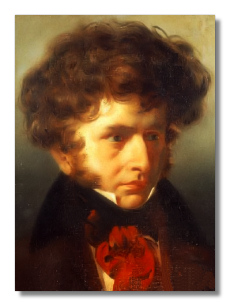
Wasn’t there to see that, though . . . Wound my way through the pre-Impressionist and Realist paintings till I found the hall devoted to Courbet. And there, on a side wall, not at all well-lit, but what do you expect in this blessed country, there it was-- Courbet’s portrait of Hector. It was darker than I’d expected, but the eyes were still burning, stern but sad and very honest and frank. God! I could have loved him! I suppose I do love him, as much as one can love a man who died eighty-five years before one was born.
I have to visit his grave before I leave this town and I’m not really looking forward to it. As mad as it sounds, I don’t want to have to admit that he’s really gone, that there isn’t somewhere in this world where he still might be.
Oh folie!
There was nothing to do now but look at his portrait and try not to weep publicly, or at least conspicuously (too late to prevent the former, I’m afraid). And to apologise to him for not having my part in the Te Deum down better and to promise him to always perform his works better in the future.
Then I stepped back and watched the others who so heedlessly or negligently passed by . . . If I were Hector and that were a portrait of Gluck or Beethoven and I heard people make flippant remarks about it as two teenaged boys did, you can be sure I’d have something very decisive and to the point to say about it. But I lack Hector’s confidence.
Looked at some other things while I was there. I’m sorry I spent so much time on the early 19th Century folks and none on the Art Nouveau artists. The Museum closed early today (they were bringing in and mounting an exhibit in honor of Mozart) so there was just no time. But I did go see the Impressionists, the Renoirs, and the Monets and Cezannes and Van Goghs. Had to, even if they weren’t Important. I needed the sense of illumination after the murkiness of the paintings done earlier in the century.
Happily, the skies were trying to clear up a bit outside. But it was a bit surreal how it was doing it, the sun gold-edging the clouds and delicately washing the domes and rooftops and the girders of a nearby Ferris wheel.
5:00 PM and trying to get dark by then so I only went over to Notre Dame and noted the time for High Mass in the morning. There were people all over the church even at that time on a Saturday evening.
Headed back to the hotel, picking up a bit of dinner on the way. Got it at a large charcuterie where they sold all sorts of prepared food from attractively lit display cases. As I waited for my order to be wrapped I noticed that the case didn’t seem to be refrigerated, even though it was full of cooked fish and seafood dishes. Seemed weird to me, but I reminded myself that just because we Americans are into refrigeration and keeping everything bone-chillingly cold, that doesn’t mean everyone else in the world has to be. They can have their own customs if they want! They probably make everything fresh and sell it fast enough that it doesn’t matter.
Trying to walk back to the rue Cujas, I learned the hard way that the Galeries Lafayette map they gave me at the hotel wasn’t worth a poop-- leaves out half the streets. I got good and turned around and good and tired before I discovered, oh hell, I’d gone two Métro stops the wrong direction along the Boul. St. Germaine. So I got on the train and came back the easy, if not so scenic, way.
On the way from the Métro stop I did something I’d sworn the other day I wanted to do as soon as I had the opportunity-- I bought a copy of one of the London papers. Paid 9F for the Independent (don’t know what that says about me or my politics-- something ominous, I’m sure) and took it back to the hotel and spent the rest of the evening reading it and eating my coquille au saumon and my piece of triple-reinforced gateau de chocolat with the blade of my Swiss Army knife. Civilization.
____________________________
†They've done some serious redecorating since then, as you may see here. And some serious price increasing, too.
Posted by
St. Blogwen
at
3:18 PM
0
comments
Labels: amiss and astray, art, Berlioz, Europe, exhaustion, food, France, hotel, local culture, love, museum, Paris, subways, trains, travel, weather
Friday, January 16, 2009
My Cut-Rate Grand Tour: Day Six
Sunday, 11 December, 1988
La Côte St. André
HÔTEL FRANCE-- Hector’s birthday dawned cloudy and gray, which has become typical . . . The sun peeked out only once: oddly, when I was reading in the Mémoires about what a sunny spring day it was when he had his first Communion.
That was after church, when I was waiting for the hotel dining room to open for Sunday dinner.
The salle à manger was filled with jolly family parties this afternoon. Interestingly, at a nearby table there was a young man who had a look of la famille Berlioz about him, especially about the nose and mouth and in his abundant mop of curling light brown hair. But he lacked Hector’s poetry and gravity of countenance. I wonder if there are collateral lines extant around here . . .
I also noticed what I think was the cause of that squeaking noise I heard last night. They have a set of Western-salon swinging louvre doors between the kitchen and dining room, and they give out a creech every time a waiter or waitress passes through.
I shall say something about dinner, since I can’t afford many such, at 125F plus wine. It began with an amuse-guele in an egg cup. Layered, with aspic glaze. First bit tasted of chicken stock then as you ate lower with the tiny spoon there was a kind of vegetable puree mixed in. Carrot and tomato, I think.
Then came a nice bit of pâté chaud en croûte.
The fish course was a cold lobster pâté with a dollop of creme dressing with chives. The slice of pâté was very prettily decorated with chives and red and black caviar. On the side was a decorative lattice of haricots verts with tiny carrot balls inside the squares. A garnish more than anything, but it was cute. This was all quite delicious.
The only real disappointment was the main course. It was bits of duck that came drowned in a brown sauce, served in a copper skillet. The meat was rather overdone and the sauce reminded me too much of the omnipresent stuff the cooks at Coverdale* make from a mix. There were scalloped potatoes on the side and they did come off, however.
I’d pretty well eaten myself into a coma by then but still sampled four kinds of fromage off the cheese board.
And then there were little bonbon affairs and then the dessert I chose, a passion fruit mousse. Thought that was appropriate for celebrating Hector’s birthday . . .
Couldn’t finish any of these, and the waitress asked if I wanted to take it with me. With my bad French I gave her the impression I didn’t and as ungodly stuffed as I was I didn’t make any effort to correct that. Rather wish I had, now.
Chose a white Savoie for the wine. Fine with the lobster pâté but I think a red would have worked better with the duck.
I’m afraid I let my gourmandizing laissez-faire run away with me, however. I know the French take their eating seriously, especially Sunday dinner, and I can spend three hours over a multi-course meal with the best of them, which this afternoon I did. However, my sitting there patiently between courses letting the waiting folk assume I had nothing to do here in La Côte except pack in their cooking really reamed me for time. I barely was able to see the Musée Berlioz and then get back to the church for the concert. And I was late at that, making it for only the last two Faurés. They were the pieces I wanted to hear, but still I had no time to wander around the town and take pictures, at all. And the bus leaves at 9:13 AM tomorrow, which in this land of eternal daylight savings time means it will be just barely light.
As Mr. Chenley† said in his letter, the director of the Musée was most friendly and courteous. He even came downstairs (after I had explained that I was a member of the London Berlioz Society) to where I was looking at the chronology to give me a keyring and medal made for the 1969 centenary of Hector’s death.
What he did not give me was his name, nor I mine. For that matter, I am not even signed in here at the hotel. Madame says last night, oh, it can wait till morning. Very nice and trusting, but I don’t really care for the idea that if I croaked up here this evening they’d only know who I was by rummaging through my baggage.
Anyway, at the Musée it’s hard to tell what room is what, as there’s no way of knowing if the furniture is arranged as it was in Berlioz’s time or if it was just put in to look pretty.‡ I did ask which one was where Dr. Berlioz taught his son Latin. It’s the room opposite the kitchen.
There’s a chair in there that was Hector’s. Forgive me, mon bien-aime, but I’m afraid I was so far within myself that it was only my intellect that moved itself to realize, "He actually sat there."
It’s a charming house, however. Very nice marble fireplaces. And a stone sink in the kitchen. And plaster walls with painted designs.
The music isn’t piped anywhere but into the reception room, to the left of the entry, but you can hear it dimly upstairs. Bits of Harold, the Hamlet Funeral March, the Waverly and Le Corsair overtures . . . Nothing vocal or they might’ve gotten something live.
I had Volume I of my 1878 edition of the Mémoires with me, and showed it to the people on the desk. I didn’t understand all their comments but I gathered it was a reasonably good find.
They gave me a copy of the Bulletin of the French Society. And I bought a monograph on Hector’s childhood and adolescence (plus a few postcards). Tout en française, à bien sûr, meaning I’m in for the long haul with this language . . . but I would dearly love to have a companion with me to whom I could speak English and who could maybe supplement my French . . .
Got back to the hotel (where I dropped off my camera) then over to the church just before they were to do the Cantique de Jean Racine. The director of the Musée was there and very kindly made sure I got in on a student ticket and found me a seat closer to the front. The choir, who I think are called "À Coeur Joie," and the orchestra, the Orchestre de Chambre du Dauphine, did a positively luminous job on the prayer. The Fauré Requiem was lovely, too, but the men were just a tad harsh in places and the baritone soloist was choppy in his phrasing. Still, they did lots better than we did in Hector’s Te Deum last Saturday. And the audience liked it. Set up a rhythmic clapping afterwards . . . but there were to be no encores ce soir.
The acoustics in the eglise St.-André are pretty good. Apparently the nave used to have a wooden roof but it’s rough plaster now. The aisles are ribbed groin vaulted. The nave piers are great fat round Romanesque ones but the arches are all pointed. The architecture is in general rather klutzy and uncoordinated (nothing aligns or matches), but it’s solid and substantial nonetheless.
In spite of or because of what I experienced this afternoon and evening, I’m afraid I feel a bit depressed. The weather has a lot to do with it and so does the language. I can get my physical needs met in it but none of my emotional ones. I hope I pop out of this before the 23rd or else I’m going to make a pest of myself when I see Lukas*. He’s liable to get a hug whether he wants one or not.
Perhaps I would feel differently if I’d been more inspired by what I’ve seen today. But perhaps the voice and presence of men of vision speak more loudly in their works than in the sites and artifacts that knew them in their physical presence. Meaning I wasn’t as moved as I’d expected to be seeing the house where Berlioz grew up and learned Virgil and the first elements of music.
But I just had a rather alarming thought. Over the last fourteen and a half years since I learned and sang the Requiem, Hector's music has become internalized for me. It's become part of my personality as much as of his, and to a degree that’s also happened with the places and things he described in the Mémoires. So when I see them in person and their reality doesn’t fit the concept I had of them in my head, they seem somewhat irrelevant. Worse, they seem to take this person to whom my soul feels so close and remove him from me, to make him a stranger like all the strangers here.
Fortunately, I brought the music along. Oh God, let it not abandon me!
I think I should take advantage of the bathtub again this evening. Heaven knows when I shall have another chance . . .
A silly note here. My missing glove you know about. But here’s the further tally of items lost so far: My luggage keys and their neck chain, pulled off somewhere between Caen and Chartres (nothing was locked, fortunately). My Youth Hostel pass which I left at the desk at Chartres (they’re supposed to be sending it to the PO at Toulouse, poste restante). And I appear to have left my slip at the Auberge in Chartres as well. Now this is really too bad. It was good enough for me to wear but with its shot elastic and safety pins, it’s really no good to anyone else. I shall have to buy another, too. Pestiferous.
I can't hear that squeaky door below me tonight, so I guess the restaurant isn't open Sunday evenings. That's a blessing, at least.
__________________________
†The then-secretary of the London Berlioz Society
‡The Musée was renovated in 2002-03 for the Berlioz birth bicentennial, so this state of affairs may well have changed.
Posted by
St. Blogwen
at
7:57 PM
0
comments
Labels: Berlioz, books, churches, clothes, depression, Europe, food, France, French language, friendly strangers, hotel, local culture, luggage, museum, music, travel, weather
Wednesday, July 04, 2007
Looking at Liberty
Some of these places didn't actually exist four years ago.
One such is the new Liberty Memorial Museum. Oh, it was in the planning stages in 2003. And the fundraising stages. And the arguing stages, with those who thought it was a desecration of the 1926 design of the building to build a large-scale exhibit space under the deck of the nation's officially-designated World War I memorial. And the preconstruction stages, when it came to the rough structure and the entry doors.
But the museum was not officially opened until last December 2nd. And today was my first opportunity to see it.
Architecturally, it's impressive. You approach down a great ramped walkway past grassy terraces and an oval reflecting pool and enter through monumental bronze doors. The entry to the exhibit space is across a glass-floored bridge, one storey beneath which are 900 field poppies, suspended in a clear medium; each poppy represents 1,000 people killed in the course of the war.
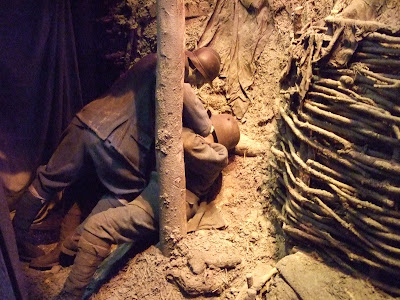
The exhibits take you through the background and causes of the Great War, its mode of fighting, its armaments, equipment, and artifacts. But especially they seek to make the visitor understand what it was like for the average soldier, slogging away in the trenches for months on end, enduring the mud, disease, and vermin that were in their way worse than the firefights that punctuated the seemingly endless stalemate. This is shown especially in the trench exhibit.
I remember when the trench exhibit was proposed. There were complaints because, some said, it would glorify war. They must have been out of their minds. How can a representati0n of a dank, fetid hellhole glorify anything?
My only complaint is that the exhibit designers chose to have these tableaux viewed either through openings about a foot square or through three inch diameter holes, both punched in a wall about what? Nine to twelve inches thick? Wouldn't be a problem, if the openings were splayed on the inside. But they're angled, so you don't get a straight shot in. And often, what you can't see is exactly what you most want to make out. I found my digital camera (set to 'natural light') was an indispensible tool. That's the only way I was able to see what was really going on inside. This needs to be rethought. Not just because it doesn't communicate fully, but more because it commits the artistic crime of making the viewer step outside his experience of the work of art and say, "Why on earth did the artist do that??" And the World War I presentation at the Liberty Memorial is a work of art.
As to the artifacts, there are wonderful things, most of them donated by WWI participants or their survivors as far back as 1919. I especially liked the long German pipes with their ornamented ceramic bowls. Then there are the ominous pieces, like the torpedo you can touch, that so like the ones that sunk so many civilian vessels, including the Lusitania itself.
In many cases, seeing various objects was like greeting old friends who've come up in the world. I remembered many of them from when they were on display in the overcrowded little Museum built in the the original 1926 campaign.I don't know what's in the old Museum space now. I had a ticket to it, and also to Memorial Hall (be prepared to weep, especially as you consider the Gold Star Mothers of then and now). But the new Liberty Memorial Museum needs at least three hours to visit by itself, and I only had an hour and a half to give.
Three hours for that, another hour at least for the old Museum and Memorial Hall, half an hour at least to go up the tower, then another half hour to take in the limestone composition of the Memorial as a whole-- you could spend the best part of a day there and not exhaust what the complex has to offer.And you come away with a salutary sense of the continuing impact of the Great War and a deep appreciation of the sacrifice of those who fought to stop old tyrannies and bring in new hope.
No, it wasn't the War to End All Wars. It was the war of its time. These battles have to be fought again and again, literally and figuratively. And it's good to count the cost-- and give the credit, for then and for now.
Anyway, I recommend that any visitor to Kansas City make time to go. It's more than worth the $8 adult admission.
Posted by
St. Blogwen
at
6:00 PM
0
comments
Labels: art, Kansas City, Liberty Memorial, museum, patriotism, travel, World War I