Friday, 6 January, 1989
Oostende to Dover to London to Oxford
The day dawned clear, bright, and beautiful. And me, not only was I up and ready in time to catch the ferry, I had time to take pictures of the ferry port with its new and old buildings, its piers, and its ships while I waited for my boat to come in.
We were underway around 8:00 AM. We cleared the harbor bars and set out into the Strait of Dover, which today was blue and calm, with an equally blue sky overhead. I spent most all of the time up on deck, watching the sunlight sparkling on the little waves and the occasional other craft that sailed past at a distance.
As we approached Albion’s yet-unseen shore, I came to understand that something has happened to me on this European trip, though maybe it started to happen when I came to Oxford last October: I was homesick for England.
Not just for Oxford or Coverdale* or Nigel* or the other people there. For England.
After awhile a horizontal strip of white began to sunder the medium blue of the sea and the pale blue of the sky . . .
Dover. It was the White Cliffs of Dover. Oh, God! It was England there on the horizon, with every nautical mile travelled growing grander and higher and more and more clear and substantial to my hungry, staring eyes. But not fast enough, not soon enough. I took in those cliffs, that shore, and I couldn’t help it-- I wept with homesickness and joy. It was England, it was home, I was coming home!
I wept, and I didn’t care. When we landed and disembarked at the Dover ferry port, I would have precipitously knelt down and kissed the tarmac, I was so glad to be back on British soil. But I was in a herd of other travellers being ushered towards the Customs station, and it would have been hard to explain my behaviour if a fellow-passenger had hurt himself tripping over me. Especially hard, considering I’m an American.
Thankfully, I had the presence of mind to get through Customs without making a fool of myself, and onto the train for London.
The train from Dover stops at Charing Cross. When I got there I discovered I’d made a false assumption: No, you can’t get a train to Oxford from there. You have to go to Paddington Station, by Underground. Okay! Got myself and my lugguge down to the Tube, and I was happy at least to note that compared to how hard it was to carry it all when I first set out a month ago, now I’m much stronger and able to manage it well, even with all the guidebooks and souvenirs I bought.
My sanguinity about this was demolished, however, when I got to Paddington Station. When I got off the Tube I had ten minutes or less to make the train for Oxford. But just as I was heading for the escalator up to the platforms, one of the straps on my canvas Boy Scout backpack broke! No way I could carry another piece in my hands, so I slung it over my shoulder by the other strap and kept running, with the bag full of books and maps bang, bang, banging away at my poor back.
Aaaghh! I hope I can find a place in Oxford to fix it! I’ve depended on that backpack since I bought it in April of 1972!
By dint of total exhaustion I managed to catch the Oxford train. Not a direct route, of course. Stops in Reading. But we got to Oxford uneventfully and in good time, and I boarded a City bus for the final leg of my journey to Coverdale College* and home.
When the bus stopped on Cornmarket, I noticed something, something linked to how I felt earlier today approaching Dover. It was dark, but I could still see the Oxford women young and old waiting there on the pavement to get on. I could see how badly they were dressed, how frowsily and dumpily they arrayed themselves, especially compared with the Frenchwomen I’d seen, urban or provincial.
And I was ashamed. I took it personally. My initial thought was, "Oh, gosh, don’t we dress horribly!" I identified with those woman, dowdy as they were. They were my townswomen, my countrywomen, even, and I wished we could all do better.
But there it is: "We." Damn, I am getting tied up in this place . . .
Friday, July 31, 2009
My Cut-Rate Grand Tour, Day Thirty-two
Sunday, December 21, 2008
My Cut-Rate Grand Tour: Day One, Part 2
Tuesday, 6 December, 1988
Oxford to Caen
LA MANCHE, 5:05 PM-- I did get a cab right quick out front. I was in good time for the station and the train to Portsmouth Harbor. Changed at Reading. I regret to say the luggage is beastly heavy, especially with me trying to get a cold and having had no sleep and no food to speak of. Providentially, I keep finding people who volunteer to carry my bag for me, for which I am grateful.
The countryside between Oxford and Portsmouth was lovely, the sun shining and the fields an intense but mellowed shade of yellow green. There was an old man in the train from Reading, where I had to change, who lives near Portsmouth and was telling me about how he used to go camping with the Boy Scouts on the Isle of Wight. He pointed out the castle at Portchester, I think it was, and said it dated from the 1000s.
The ferry was late coming in, due to choppy seas. We didn’t get underway till way after 4:00 (3:00 PM is proper sailing time) and shan’t be in to harbour till very late. I do hope the bus into Caen is still running.
This is a French ship, the Tregastel. It’s like Montréal on board, in that the staff all speak French primarily but since their English has to be good, too, I feel a little foolish practicing my rudimentary French. Thus far I have been mixing it, and not adding in any Russian. We will see how I handle it when it comes time to buy dinner.
It’s a pity we got started so late. It’s quite dark now and I won’t be able to get a view of the open sea. There is a bit of a swell, producing a feeling as if the ship were making a continual righthand veer and rather as if one had gotten pleasantly tiddly. It’s making me quite sleepy . . . .
10:20 PM, FRENCH TIME-- Did you know the French are an hour ahead of the Brits? Whether it’s got to do with the country’s longitude east or if they just never go off Daylight Savings Time, I don’t know. Well, that’ll give me longer to see things in the afternoons, though an hour less sleep tonight. If I’d known we’d be this late I’d’ve hired a cabin and stretched out. As it was, I nearly fell asleep sitting at a cafeteria table before dinner.
Turned out I had no option about using French when trying to get something to eat. The chef-cum-server didn’t have any English. English food though: fried fish and chips, all luxuriously greasy. Poisson et frites, s’il-vous-plait!†
When I was finished and started to unwrap the chocolate angel Friedhelm* gave me the other day (I remembered to take it with me at the very last minute and ate it this evening so it wouldn’t get squished in my new satchel), the man who carried my suitcase onboard for me this afternoon came by my table and asked me, in French, if I were French and returning home.
No, I told him, je suis une Americaine.
He eventually sat down and we had a nice long chat. He had no English at all and you know about my French. We did communicate after a fashion and I think I got the gist of most of it, if not the details. It was hard to tell if, when I couldn’t follow him, it was due to my lack of vocabulary or to his digressive style.
I think the latter, in the case of his telling me about his friend who has a fishing boat in Brittany and then getting off on the tale of all the American tankers that’ve broken up and left oil slicks all over the Bretagne beaches. Maybe I missed something about how the fishing wasn’t as good as it used to be.
He lives in a suburb of Caen, had just been over to England for the day, and was now coming back. Likes boats. He says there’re about seventy hotels around Caen. I just hope I can find one whose proprietor won’t be angry at being rousted out at midnight.
It shouldn’t be much longer now. I’ve been seeing lights on the horizon for over a half hour and we appear to be drawing even, as I write.
(It’s 11:10 PM.)
CAEN, 1:10 AM-- My Norman helper continued to keep me company off the ferry and into Caen, until he’d seen me into a hotel pres de la gare ["close to the train station"]. I never got his name. Though I suppose I could’ve, if I’d been quicker on the uptake. For some reason on the bus from the ferry port he was trying to tell me his birthday and ask me mine, and when I didn’t understand he showed me his entry permit, which certainly had his name on it. The interesting thing is that his permit said he was born in 1948. My apologies, but I would’ve said he was nearly ten years older than that. That’s a year younger than Eric* [a former (single) architectural employer]. But then, Eric’s always been a handsome cuss. That’s why I put up with him for so long.
Continued fun with the French language. I have to work on my numbers and stop adding them up in the air in front of me.
He asked me if I’d been speaking French in the US. No . . . (only to myself and in writing, which I want to express untoward thoughts towards ineligible objects . . . ).
Passed the château on the way here. Lit up at night. It was William the Conqueror’s. Of course! Survived the bombing in WWII, apparently.
Settled on a hotel near the station. Whole string of them here. This one is called L’Hôtel du Depart. Up the street a ways is L’Hôtel du Arrive. Humorous people, these Normans.
This place strikes me as odd, but I think I’ve discovered why it doesn’t seem quite as nice as it could be. It’s because this whole street (or place) is totally packed with hotels and brasseries, and I think subconsciously I was affected by thoughts of Honolulu’s Hotel Street, famous from Magnum and Hawaii 5-O. And it is not a nice place.
This is setting me back 100F [about $20 at the time], with a sink and a bidet in the room and WC down the hall, just like at Coverdale*-- except for the bidet. I can’t find the light for the washroom, but that’s like Coverdale, too, where according to time-honored Oxford tradition, the mirror is small and in the darkest corner of the room.‡ I can see how God has used this past fall to get me used to such major trials and tribulations as these.††
Speaking of WCs, I’d read of how casual the French are about bathrooms and I witnessed that one on the boat.
Actually, I made the first faux pas. Just after I’d gotten on board I saw a sign saying Toilet and so I went and used it. On the way out I noticed the urinals and wondered if it were a coed john, again like Coverdale-- until I got to the door and noticed it had a pictograph for "Men" on it. I was glad no one else was around to see.
But then just before dinner, I was in a bona fide ladies' room, getting ready to wash my hands, when a man came in and quite matter-of-factly headed for one of the stalls to use the stool. (Stall door closed, of course.) I quickly stepped out into the passage to verify that I hadn’t made the same mistake twice--no . . . So I (mentally) said ok! and went back to the sink to do what I was doing. My nonchalance may’ve had something to do with yesterday evening, when I was the casual witness to the scene of several future vicars stripping to their briefs and changing into their pantomime costumes in front of God and all the rest of the cast. Nic Chistlethwaite* had some really brief black ones on but he’s no good for a cheap thrill-- he’s too skinny.
The decor here is basic Motel-6 in a blue version (chenille bedspread exactly like the ones at Covers) but the plumbing fixtures are new and nicely-designed. And I am greatly enlivened to see that the closet door is fitted with one of those plastic and metal foil recessed pulls, from Häfele or Ironmonger, such as we found to be useless at the Griffons’ [a residential project I'd been working on in the States]. Here they solved the problem by fastening a screw straight through the middle and into the wood. Tacky-- but effective.
_______________________
†NB-- I'll translate the French, German, etc., only if I think the meaning may not be obvious. But unsupplied translations cheerfully made upon request!
‡Dorothy L. Sayers allusion, from Chapter 1 of Gaudy Night
††Warning! Major self-deprecatory sarcasm alert!!
Posted by
St. Blogwen
at
11:45 PM
3
comments
Labels: architecture practice, boats, delight, England, Europe, food, France, French language, friendly strangers, hotel, local culture, luggage, trains, travel
Monday, October 20, 2008
My Great Britannic Adventure, Day Twenty-two
Friday, 7 April, 1989
Moatenden to Great Dixter to Bodiam to Hastings to Oxford
Day Twenty-two
Breakfast was in the big, low-beamed kitchen. Last night Mrs. Deane showed me one of the ceiling beams that some archaeologist was specifically interested in, as to its antiquity and date. Going from Cecil Hewitt I would’ve thought the original structure was rather different from what this other man had surmised, but then I’m just a novice at this sort of thing.
I’m afraid I was rather behind getting to the meal. But Mrs. Deane was quite cheerful about getting me my eggs on her big Aga-- after all, her son had just come in to eat, too; thereafter to help deal with some workmen who were expected in.
The Londoners were finishing their holiday today, too-- their daughter’s school was restarting soon. We all traded horror stories about driving in London, and then Mrs. Deane invited us to walk about in the garden, if we would, before we left.
Sadly, it’s still rather awry from the big storm in October of ‘87. She hasn’t been able to get the tree surgeons in to deal with all the broken limbs. And a lot of the plantings besides those trees were destroyed.
Still, it was nice to walk to the back of the garden and contemplate the daffodils beside the watercourse. Funny, but Mrs. Deane told me that the moat that gives the Priory its name was originally a dry one. Moatenden Farm, just across the moat to the north (and a separate property) has oast houses. Be fun to see inside one sometime.
Picked my way round to the front, to get a view of the 12th century bit in front. It’s mainly just the doorframe and so forth at the kitchen end-- the brick nogging dates, I’d say, from the late 1500s, early 1600s.
After I got my things together upstairs, I sat down and wrote postcards. That done, I settled accounts, loaded the car for the last time, then drove away south. Stopped in Headcorn, where I posted the cards. Great fun--it started raining, hard, as I dashed back to the car-- then just as quickly stopped again.
I thought of heading generally northwest, meeting up with the M25, then catching the M40 straight back to Oxford. That’d certainly get me there by car-turn-in time at 4:15. But it seemed rather dreary, and anyway the rate the M25 goes, I wasn’t so sure it’d be all that quick. Besides, I had a hankering to see the sea again, feeling I mightn’t get another chance while I’m over here. So on to the south it was.
I’d read somewhere that Great Dixter doesn’t open on weekdays till the end of May, but just for jollies I followed the lane to it when I hit Northiam, just to see.
Well, it is open weekdays, but not till 2:00 PM. Oh. Only 11:00 now. That’d mean another day’s car hire. Oh, well.
The man in the nursery, which was open, pointed out Bodiam Castle which you could just see on the horizon to the west, only about four miles away.
Well, why not?
So I followed the little lanes down and around and soon was there.
Bodiam Castle is such an odd little thing, especially after places like Warkworth and Caernarfon. It obviously meant business, sitting there so solidly in its wide moat. But still you get the impression of a small swaggering person who defies people to attack him. One backs off, just in case, but one is still left wondering if one’s leg is being pulled all along.
Worked my way round the moat counterclockwise, as the sun dove in and out of the clouds, till I reached the main entrance. Other visitors were going in and I decided that if admission was free, I’d look in. But if not, I hadn’t the time.
It was 90p. OK! It’s off again we are.
Wended along over to the A229, heading for Hastings. In Hastings the main roads don’t indulge in any such American nonsense as a bypass. No, the A229 went straight down to the seaside. There you pick up the A259 which runs parallel to the water, with the big hotels on one’s right.
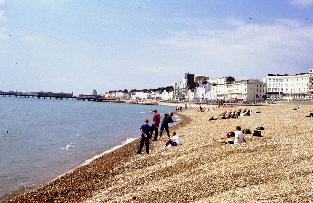
The sea was in magnificent form today, sending great towers of spray over the sea wall and onto the windshield of the car where I’d pulled it over to get out and see. The waves thundered gloriously and I was sorry I had to be on my way so soon.
Decided to take the seaside road as much as I could. Went through Brighton, where I could glimpse the Royal Pavilion, freshly restored, I am told, on the right. And Shoreham by Sea, and on to Worthing.
It was there that I knew I’d have to give up my plan, for although it’s nowhere near high season a plethora of other trippers had the same idea I did, apparently. The sea road was incredibly clogged and slow. I made it partway through Worthing when, considering how shockingly fast time was getting on, I backtracked a ways then got myself onto the A27, a bit to the north.
That was much faster-- it even has dual carriageways in places-- and except for lacking the view of the Channel was just as pretty. I love so much to see the sheep on the sunlit green hillsides! It’s as if so many fluffy white flowers had sprung up and blossomed in the space of a night. And the view coming down the incline into Arundel is simply breathtaking. The castle and cathedral were bathed in light, made much more dramatic by the clouds gathering to the northwest.
Again, though, no time to stop-- I had to press on.
Not that I didn’t pull over a bit farther on-- I stopped and got out to take photos of the thunderheads piling up over the downs-- they looked so Midwestern!
As I entered Portsmouth, around 2:15, I saw that the needle on the petrol gauge was riding rather low. I started to look for a Shell station, figuring that since everyone’s gas is overpriced here I might as well patronise the oil barons my mother works for. And soon I spotted one-- on the far side of the divided road that the A27 becomes as it passes through the northern regions of the town. But there were no legal right turnings I could see for blocks and blocks.
So at next opportunity I made a left into a residential neighborhood, then another, then another, round the block hoping to find a cross street that’d intersect with the highway and allow me to backtrack to the filling station.
As I was on the northward leg of this square I passed a cyclist, giving him plenty of berth. At the end of the block I could see, as I approached, that the way ahead was blocked-- there was indeed a bridge over a stream or ditch, but closely-spaced bollards closed it to motor traffic.
Well, rot. I put on my turn signal in good time and when I reached the T-junction, turned left yet again.
All at once, I heard a bump on my left rear fender. A cry came from the road behind me, more of wrath than of pain. Chilled with apprehension, I stopped the car and looked back-- to see the cyclist lying on the ground just short of the intersection, his supine bicycle spinning its wheels beside him.
Well, you know me, especially when I’m tired and hungry and rather frightened besides. I ran back to the corner, grateful to see him getting to his feet, and said, "Oh, I’m so sorry! I didn’t see you! I’m so sorry! Are you hurt?"
The cyclist, a rather regimented-looking young man of about twenty-seven or so dressed in a BritRail messenger’s uniform, flexed his ankle and said, "Well, I suppose it’s all right," adding accusingly, "no thanks to you."
I went off on another volley of apologies and blametaking and he was well-satisfied to give me a grim little lecture on the rights of cyclists and the rules of the road. It was so shame-making-- for as one who for years got around mostly by bike, who should know such things better than I?
Then he got out his walkie-talkie, with another comment about how it wasn’t my fault that it wasn’t broken, and radioed his office, giving them the license plate number of the hire car and my driver’s license number and all the rest of it.
Immediately fears of horrendous lawsuits swarmed into my head-- maybe I wouldn’t be allowed to leave England. And whatever would the EuropCar people say?
Finally, as if he were a traffic cop and not an accident victim, he sent me on my way, saying cynically, "Next time you run down a cyclist, try a little harder-- maybe you’ll do a better job of it"-- as if I’d gone after him on purpose.
I found the way to the Shell station and got a fill up and a chocolate bar. I wondered morosely and guiltily what the attendants would say if they knew what I’d just done.
Continued on into Southampton, where I got a little lost trying to hook up with the A34 going north. It was around 3:00 by now and the primary schools, with all their uniformed scholars, were letting out. This forced me to take it specially slow-- another accident I did not need.
After I got on the A34 and up past Winchester, my head began to clear a bit and I got to wondering. How could that accident have been my fault, since he was the one who’d hit me, presumably as I’d turned the corner? And how, since I’d passed him about even with the previous cross street, had he managed to come up on me so fast, and why? And considering that I’d signalled for a left and the way ahead was blocked, how could he for a moment have thought that I wasn’t going to turn left, or have been such an idiot as to think he could pass me before I did? For afterwards he’d gone off straight ahead across the bollarded bridge.
And in place of my fear and guilt came a swell of anger-- anger at people who can so cleverly blame others for their own foolishness and at myself for habitually being such a patsy for that sort of person.
The day and my mood rapidly deteriorated as, short of Newbury, I came upon a backup that the radio said stretched out for ten miles and for which their traffic reporters would propose no explanation. All I knew was that it took a half hour to go five miles and my chances of making it to Oxford by 4:15 were to hell and gone.
When I got to Newbury, I discovered the problem-- It was simply the glut of Friday travellers and commuters taking their turns getting through the Newbury roundabout. Damn this road system! Haven’t these people heard of a proper interchange?
Thank God the road was clear after that.
I’d planned to reenter Oxford by the eastern bypass, by way of Littlemore and Cowley, but saw there was no way. It was 5:00 already and the hire office closed at 5:30. So I came up the West, got off onto the Botley Road, and wended my way through the rush hour traffic by way of Beaumont Street, finally reaching Banbury Road and Coverdale*.
Fast as I could, I emptied out the car, dumping my luggage in the basement flat [where I had been moved during the vac]. That done, I dashed back across the Chapel passage and back to the car.
Fought off the Oxford traffic back to the Botley Road. There I perpetrated an act that put the crown of absurdity on this whole confounded trip-- I mistook, or misremembered, the way into the carpark for the shopping center where the hire place is. Instead I found myself on the highway on-ramp and thence heading southbound back down the A34.
I didn’t care who heard me, I screamed in frustration! In an access of self-disgust, not to say self-destructiveness, I gunned the engine and as my speed mounted I didn’t give a holy damn if I were arrested for speeding or cracked up the car or committed whatever other mayhem.
But I couldn’t help but see the Palm Sunday cross that’d been hanging from the rearview mirror ever since Saffron Walden. And a more sensible voice reminded me of what a bad witness it’d be if I did something foolish with that present to proclaim me a Christian. Chastened, but still very upset, I slowed down and turned left into what I discover is Yarnells Road. This took me to North Hinksey Lane and back to the Botley Road.
This time, I didn’t miss the turning to the car park. And thank God, though it was 5:40 the EuropCar office was still open. I told them about the cyclist and filled out a report on the smashed door I so cleverly acquired in Stamford. The girl at the counter agreed that my second-thoughts version of the encounter in Portsmouth was probably the accurate one. She told me not to worry, they’d take care of it, since it was properly reported to them and she’d taken the particulars down from me in writing.
I couldn’t get my deposit back yet, as all the cash was locked up for the weekend. And I nearly forgot my Palm Sunday cross, running back to retrieve it.
I did not take a bus back to Oxford. I’d had enough of vehicles for quite awhile. Instead I loitered along the Botley Road, pausing to inspect the little ramifications of the Thames as they passed under each bridge I crossed. I stopped to see the locks at the Osney Bridge, coming down into East Street for a closer view. At one point, I passed a young guy who was trying to hitch a lift into Oxford. I nearly laughed in amusement as I told him, upon his inquiry, that the city was only a short distance ahead-- he’d might as well walk. Everything was bathed in a golden western light and as calm returned I felt a great sense of proprietary affection for my city as it appeared ahead.
And so to New Road, round by the castle mound, and thus by Queen Street to Carfax. It was a little short of 7:00 and I just had time to pop into the Coop on Cornmarket for some milk and other supplies.
Thus provisioned, I strolled up Magdalen, up St. Giles, and finally to the Banbury Road and Coverdale College*.
I’ve been utterly useless the rest of this evening. I made myself supper and took forever eating it at the desk in the little bedroom down here. And, ignoring the luggage that wants to be unpacked, I’ve finished reading Scott’s Heart of Mid-Lothian (and rot him, need he be so predictably moralistic in the end?).
The college is still overrun with those absurdly embarrassing students from Bemidji, Minnesota, and I still don’t know how I shall deal with the problem between Lukas* and me. But away with all that for now-- I’m back at Coverdale*, thank God, I’m home at last, I’m home!
Posted by
St. Blogwen
at
9:00 AM
2
comments
Labels: accident, architecture, bed and breakfast, bloodymindedness, castle, delight, driving, England, frustration, gardens, Great Britain, history, Kent, livestock, Oxford, photography, weather, woe
Wednesday, September 17, 2008
My Great Britannic Adventure, Day Twenty-One
Thursday, 6 April, 1989
London to Rochester to Canterbury to Moatenden (Kent)
Day Twenty-one
Got up and dressed in time to go feed the meter a pound or two. That was only good for an hour but that’s all the meter will give you in the daytime.
Phyllis* was already gone to her job but one or two of the roommates was rattling around. Didn’t see any of them, though.
Made myself some breakfast then got out of there, bag and baggage, around 9:00. Did not want a ticket.
I’d made no particular plans for today, but I thought I’d like to see Westminster Hall. So I muddled through the very slow London traffic, figuring I’d get down to the Parliament buildings and check out the parking and take things from there. But when I hit Parliament Square the sidewalks were lined with people behind barricades and bobbies everywhere. Parking situation didn’t look hopeful enough to even mess with. So I took the Lambeth Bridge south then started looking for the A2 to Canterbury.
This morning I took a version of Phyllis’* advice of last night. I spotted a coach with a Kent logo on it and followed it. Although the way to the A2 was fairly well marked, staying in the wake of that light green coach made things a lot easier.
I was well into the suburbs when I heard on the radio that all the hooha in Westminster was because Mikhail Gorbachev was in town today, Raisa in tow. Another good reason to skip town. That could’ve been a zoo.
The signs for Rochester came along just before the junction of the A2 with the M2. I decided what the heck, as Dr. Gendle [my Oxford medieval architecture history tutor] says the castle’s worth seeing, I might as well look it over as long as I’m here.
You go through a town called Strood first, then across a good big stretch of the River Medway, before you get into Rochester proper. The downtown is still pretty old looking but they obviously do a good deal by way of shipping. I parked the car on the street under the castle wall, opposite a marina.
The light meter on the Minolta is definitely screwy. The ring on the lens is stuck and the lollipop and stick never line up. So first item on the agenda was to find a camera store on High Street and get it checked.
The man there says the meter’s fine, if you disregard the fact that the f-stop ring on the lens is stuck. I nearly let him sell me a used exposure meter but the thought of having to fiddle with it was too tedious. Besides, I’ll see about getting the camera fixed in Oxford, this weekend. Did get a typical reading for today’s cloudy conditions and that’ll have to do. You’d think that after fifteen years of using that lens I’d be able to set it without the meter, anyway.
Well, we’ll see.
Another thing-- the camera’s case smells like beer. That’s strange, because I didn’t have it in the pub with me Tuesday night.
It was mizzling a bit when I got back to the castle. Came in by way of King John’s round turret, or rather, through the encircling wall to the left of it. The castle entrance is up some modern steps to the forebuilding. Inside you meet the admission desk and the postcard concession. Your tariff paid, you turn right to go into the castle proper-- though it’s more like going outside, since the hall and solar are now roofless all the way up.
The circulation is all around the perimeter, with stairways in the corner towers. Kept having to remind myself that the stairs wouldn’t’ve been so precariously worn in the 11th and 12th Centuries. But still, the old owners had a fine disregard for the niceties, like railings and uniform riser heights, considered so necessary by 20th Century American housing codes. The National Trust has supplied the railings, but some of them were wet with paint today. It was really too bad for some of the other visitors, such as some women wearing medium-heeled shoes. With my suede waffle-stompers I was fine.
The central wall is still there, of course. I’m trying to remember if one of the shafts in it was a rudimentary sort of dumbwaiter, or if that was just the loo. Pretty fancy loo, if so.
The castle also has some nicely-carved fireplaces for the various chambers. All very up to date and civilised, for the time.
They’ve built a new roof, with a skylight, over the chapel, which is in the upper storey of the forebuilding. It looked better-preserved than the rest of the castle. It got me thinking about the religious attitudes of the old inhabitants-- were they sincere Christians or just using God (like so many of us do) as an endorser of their own plans and prejudices--in their case, the making of war on their neighbors? From our pacifistic perspective it’s easy to think the latter, but who are we to judge?
Could’ve done with less rain today. Used the flash a lot, which overcame some of the meter problems. Deliberately set it low to preserve some of the effects of the subdued lighting.
After the purchase of two or three postcards, I went out and took a look at the remainder of the castle grounds. There’s a very fine dogtooth-moulded Norman archway to the northwest-- except that it’s a restoration. I feel so ambivalent about that.
Skipped the cathedral-- no time to satisfy mere curiosity-- and returned to the High Street in search of something portable to eat. This town turned out to be remarkably short on fruit stands, which is what I really wanted. But I got a box of shortening biscuits from a grocers and a couple of disgustingly greasy pastries called Eccles cakes from a bakery and returned, dripping crumbs, to the car.
Took off at around 1:00. Tried to be creative on my route out of Rochester but I only succeeded in getting myself sequestered down a potholed, dead end lane. Back across the bridge across the Medway and through Strood, then.
Listened on the radio to the effusions of enthusiasm for Gorby and company that were coming out of London. I can’t believe the simplemindedness of some people. They probably think Mrs. Thatcher’s a spoilsport because she advises caution.
Back on the M2 and thereby to Canterbury. Cute town, lots left of the ancient city wall. But with all those generations of pilgrims and tourists you’d think they could do better regarding parking. I drove round and round and round, literally, before I found a carpark that had spaces, let alone one that was affordable. And we were talking 40p per half hour, at that.
Anyway, ditched the Astra and threaded my way though a pedestrian mall in the city center and eventually found myself at the Cathedral.
More scaffolding, lots of tourists. Expected by now, and at least it wasn’t high season.
Entered by way of the southwest porch. But I couldn’t hang about contemplating the nave, as one is required to purchase a photography permit. You get that at a little bookstall in the southwest transept. So I made my way there first.
After that, I passed between the parish altar and the massive choir screen to the northwest transept, to where it all happened in 1170.
It’s a little daunting to consider that-- there’s no doubt of it whatsoever-- in this very spot St. Thomas á Becket was murdered. And whatever you may think about the relative merits of his case and of Henry’s, there’s still the fact that Thomas was upholding as best he knew the will of God. There’s an immediacy about being there, even after these long centuries, enhanced by the evocative modern sculpture, a cross formed of two jagged swords and their scabbards, set above the altar. And behind you is the cloister door through which the four knights entered . . . Kyrie eleison!
There was also a plaque commemorating the occasion on which Pope John Paul II and Archbishop Runcie prayed there together. Very sweet and ecumenical, what?
Took the stairs down to the crypt, with its chapel and treasury. There’s a sign reminding people that that’s still part of the church, but some boys down there hadn’t got the idea. I refrained from adding my admonishments to the noise, though.
Quickly scanned the display of church plate then reëmerged back up around in the southwest transept. Being limited as to time I didn’t spend much time in the choir, rather I crossed quickly again northwards and climbed the aisle steps to the Trinity Chapel. They’re a big flight of them, but I decided that if all those people for all those centuries could make it up without complaining so could I. It was piquant to think I was making my own Canterbury pilgrimage, anyway. I liked the sense of heritage.
The glass in the Trinity Chapel is absolutely brilliant, in any way you use the word. God, those glaziers know what they were doing! 17th Century Flemish stuff is cut and paste in comparison.
While I was contemplating the Becket miracle windows the PA system came on and a man’s voice welcomed the visitors to the cathedral. It also reminded everyone that this is not only a tourist attraction but also a house of worship and prayer. After informing us when the evening service was to be, the voice requested everyone to please bow their heads for the Lord’s Prayer. I knew there were a lot of French tourists about today-- there always are, lately-- and I wondered if they’d know what was going on.
Apparently so, because although not everyone seemed actually to be praying, the noise level, blessedly, went down.
I wonder who that was on the PA. Robert Runcie himself? No, probably not . . .
I passed around then and stood before the spot where Becket’s tomb once stood. There’s nothing left of it now-- Henry VIII and his successors made sure of that. But still, at the site of the final earthly lodging of a determined and visionary cleric I was moved to pray for the ministers soon to come out of Coverdale College*, for their ministries and vocations, and especially for Nigel’s* . . . O sancte Thoma, ora pro vobis!
To the east is the Corona with its altar-- it’s roped off so you must survey the glass there from a respectful distance. The Jesse Tree window is there.
I came back round via the south aisle of the Trinity Chapel; I was disappointed to see that both St. Anselm’s and St. Andrew’s Chapels, pre-Becket parts of the Cathedral, weren’t open to visitors. But as long as I was now back on the north side, I popped out to see the cloisters. They’re elaborately fan-vaulted, and ornamented with everybody’s and everyone’s shields and arms.
The Cathedral bookstall, in the southwest transept, didn’t have as many nice postcards as I would have wanted. Still, I purchased one or two and was reminded at any rate to go visit the West Window with its image of Adam delving, before I departed. It’s some of the most ancient glass here.
Couldn’t stay much longer, though: I was afraid of getting a parking ticket. But I did pop into a souvenir shop on the High Street and got more postcards and a nicer Cathedral guidebook than they had in the church itself.
One thing they didn’t have was a copy of The Canterbury Tales in the original Middle English. Nothing but modern. If it could be done with sufficient economy, it’d be neat to have an edition that was dual-language, with illuminations.
Got back to the carpark by 4:30 or so; no ticket, thank God. Got out onto the A28 and headed southwest.
I really love the names of the towns in this place! Between Canterbury and Ashford there’s actually a town called "Old Wives"! Is that the original site of the original tales?
Got the A262 then the A274 and began to look for Mrs. Deane’s guidemarks for Moatenden Priory-- except for doing it the other way round: she’d assumed I’d be coming from the north. They were good directions and I spotted the turn-off just fine. But as I wasn’t expected till 7:30 and it wasn’t even 6:00, I overshot it on purpose and drove up to Sutton Valence to see what I could do about dinner.
Not much, there. I stopped into the local pub. They weren’t serving proper dinners yet, since the cook wouldn’t be in till 6:30 or so. But I could have a beef burger for around six quid. What is this, London or something? I declined and drove down the lane to Chart Sutton. But the pub there wasn’t open yet at all.
Oh well! So I’ll be early!
Mrs. Deane, the white-haired lady who owns Moatenden Priory, didn’t seem to mind. She showed me up some narrow steps to a good sized room overlooking the back garden. It had a fireplace (plugged up, unfortunately), nice dark-wood furniture (including a glass-fronted case full of books), and two twin beds, one of which had a coverlet of patchwork deerskin, with the hair still on. The other had a synthetic thing that was more or less supposed to match it, in a fake fur sort of way.
The other people staying here, a couple from London and their grown daughter, pulled in before I could get my things out of the car. It was a pity, because otherwise I could’ve moved mine and got an unobstructed photo of the front of the house-- part of it is 12th Century.
All day I’d been wondering why the back of my Minolta smelled of beer-- and now I found out why: The lid of the jug of cider I got in Taunton yesterday morning was loose. Oh, boy, are the EuropCar people ever going to love me!
Mrs. Deane suggested I try Headcorn for supper. I’d decided that since it was my last night out I’d splurge on one. The people in the local there were rather friendlier and the prices weren’t so ridiculous. I still had to wait for the cook to arrive, though, so I retired to a table with a half pint of ale and Walter Scott and sat back to observe the goings on.
It was rather different from the Plough in Somerset. The people here came filtering in wearing jackets and ties-- good chance they’d just finished a commute from London. And when one bloke pulled out a portable phone and made a call, I almost burst out laughing, it was so incongruous. Because for all that, it still was a basic British pub, with kids running in and out (the boy may’ve belonged to the landlord) and the usual decor, enhanced in this case by airplane memorabilia.
I ordered roast beef with peas and potatoes and was glad to get it, too. Can’t get it at Coverdale*.
Back at Moatenden, I sat down in the little white painted hall reading in front of its great fireplace and making faces at the little dogs that trotted in and out. That fireplace is taller than I am-- I could’ve walked right into it. The fire on its bed of ashes and coals occupied one corner-- you could just imagine pulling a chair into the other side of it.
I didn’t see any other of the company while I was there; I retired to bed around 9:30. I decided, even though I’d been sitting on the bed with the fake fleece coverlet, to sleep on the other one-- one doesn’t often get a chance to slumber under deerskin and I doubted I’d ever have such again.
Posted by
St. Blogwen
at
3:29 PM
4
comments
Labels: architecture, bed and breakfast, camera, Canterbury, castle, cathedral, delight, driving, England, food, Great Britain, history, Kent, London, Middle Ages, photography, pubs, Rochester
Monday, August 18, 2008
My Great Britannic Adventure, Day Twenty
Wednesday, 5 April, 1989
Holford to Taunton to Salisbury to London
Day Twenty
This morning at breakfast there was smoked haddock, the first time I’ve had any on this trip. It was a nice change from bacon.
The weather didn’t look too cheerful as I headed down the little road to Crowcombe and thence to Taunton. Still, we put the Beethoven sonata tape in the player and make the best of it.
In case you’re wondering, I was not going there again because Somerset's county town is such a tourist magnet. I had absolutely no cash in my purse and had to hit the NatWest to cash some Traveller’s Cheques. And I wanted to buy some Somerset cider.
Worse finding a place to park today than Sunday, not surprisingly. Finally got a slot in a half-hour zone a couple-three blocks from downtown. Hustled and managed to accomplish both goals in the nick of time. Last thing I want is a ticket.
The cider’s in a plastic jug. No temptation to take it home to America that way, though I really would’ve preferred the stoneware container.
It was after noon when I'd completed my errands and left there, so I had to skip going back to Bristol to try to see the Clifton Suspension Bridge by day. Would’ve been no improvement over last night, anyway-- cloudy again. Instead I went south on the A358 to pick up the A303 east at Ilminster, to make it as expeditiously as possible to Salisbury.
Of course I managed to get lost on the way, or I thought I was, which comes to the same thing. Backtracked thinking I’d missed the turn for the A36, wasting all sorts of time and petrol in the process, only to discover I’d been ok all along. It’s a good thing this car comes with unlimited mileage.
When I got to Salisbury I drove around till I found a place I could park for a couple hours free on Mill Road by the Queen Elizabeth Gardens. That gave me a better view of the cathedral than a close-in position would’ve, though it isn’t the angle so often painted by Constable, I think.
I walked along the water there as close as I could come, but they haven’t thought to provide a bridge whereby you can reach the cathedral from that angle. So I had to walk all the way around to the High Street after all.
First thing apparent on this fine foggy day is that the West Front is being restored. More scaffolding (do I hear a March somewhere?). You can’t have everything, though.
The interior was different from what I expected and a little disappointing as well. It seems odd to say so, but all my reading and photograph-taking had led me to believe it would be a lot more-- well, cleaner. And instead I found it neither austere, nor rich, but merely cluttered-- and mostly with tourists. A great many French ones, many of them there in student groups. But that seems to be the case in most English cathedrals I’m visiting this trip.
The dark gray Purbeck shafts of the nave and triforium are very smooth and nice, but damn, don’t they subdivide the vertical space! One horizontal band on top of the other.
The really odd thing is the Trinity Chapel, at the east end. The Purbeck shafts there are unbelievably tall and slender. They look hardly able to take the weight of the vaults, light-looking as those are.
Got a good look at the inverted arch in the eastern transept, to figure out to where the mouldings go . . . Actually, they just die into an unengaged column on each side. Not the most polished or professional solution one could imagine. I wonder at what stage those were put in.
They’re installing a new organ in the northwest transept. The case wasn’t entirely built and I could admire the big diapason ranks.
The Trinity chapel is dedicated to Prisoners of Conscience. I can’t help thinking, it’s not enough to be sincere; you can be sincerely wrong. But still, Amnesty International is right-- you can’t go jailing people just because they’re Communists or whatever. That seemed to be the case of the South American student who is their prisoner of the month.
Yes, the title does sound rather hokey, doesn’t it? At least, some of the French students really thought so. Gave them a good laugh. And me a blow to my romantic conception that all European students are such socially-aware people.
It’s not only the west front that’s being renovated, it’s the tower and roof as well. You can’t go anywhere in that church without encountering a display illustrating the need for urgent repairs. But it is imperative something be done, so I threw in a pound in addition to my admission ‘donation.’
They have one fund-raising idea which wasn’t exactly the most atmosphere-preserving activity but still is an interesting concept. They’re releading the roof and to raise money they’ve divided several sheets of the lead into boxes maybe 1-1/8" high x 4" long. For £2 you can use an electric engraving tool and inscribe your name, origin, the date, and anything else you like, within good taste and reason, and it’ll go up on the roof.
I decided what the heck, why not. But of course I have to be Creative. So towards the upper middle of sheet #39 (you can ask them when on a roof tour and they’ll show it to you), I have
Blogwen X--
Kansas City, USA
5 April, 1989
Gloria in Excelsis Deo
All done in a very shaky version of my Celtic lettering-- shaky due to not having eaten since breakfast (it was after 4:00 by now) and just plain nerves. Still, it was enough to excite the natives. And who knows what it’ll inspire.
I actually wasn’t feeling very Gloria in Excelsis but the attribution is appropriate, regardless of how I feel. And besides, it’s a good motto for a roof.
Obligatory visit to the cathedral shop for a postcard or two, then I strolled around the cloister. Peeked into the chapterhouse but didn’t go in-- couldn’t afford the time and didn’t care to pay the extra money.
Out the west door to admire as much of the facade as was visible behind the scaffolding. It started to rain so I skipped making a full circuit of the building.
Left the cathedral grounds and walked up the High Street in search of a phonecard box. Found one, and tried calling Royal Festival Hall about where to park for the concert this evening. But got no answer. They must close at 4:30.
Tried to locate a bakery or whatever in the immediate vicinity so I could buy something to pretend to be dinner, but with no success. So tonight we’ll live on Berlioz. No problem.
Got petrol at an off-brand station just out of town. I asked and they didn’t take traveller’s cheques, not even in pounds sterling. Very strange. Visa was all right, luckily.
Got on the A338 north (at about 5:00) to pick up the A303 past Andover and then to get the M3 near Popham. The motorway goes past Basingstoke. My dialects book says that down here it’d be taboo to say, "Basingstoke is a fine and purdy town." But I had no opportunity to take an exit and find out why that’s not the sort of thing one should say. I had other things on my mind. Making it to London in time, for one thing. And the weather, for another.
Jolly entertaining stuff, that was. It started snowing before I left Wiltshire and in Hampshire it was coming down pretty hard-- and sticking. Not on the road, though. Little chance of that with the volume of traffic. The highway code says you’re not supposed to put on your fog lamps unless there’s actually a fog. I don’t care, I turned them on anyway. Everybody, and that obviously includes me, was trucking along at 80 mph just as if nothing was unusual about the conditions and I did not want to be rearended by some half-blinded speed merchant.
Passing trucks was the most fun. You go sightless with the spray. I suppose the greatest potential hazard is coming up on people ahead who’re going more slowly than you’d thought. It was all very entertaining.
Still, I made good time and was in Richmond, around fourteen miles from the center of London, at 6:30. The rain and snow had stopped by now but I was in city traffic, of course. But inbound was moving decently, at least. Should’ve been no problem to make it to the RFH in time and with time to spare for dinner, maybe, too.
Should’ve been. But I hadn’t planned on my old nemesis, the badly-labelled road, catching up with me again. I was trying to get on the eastbound South Circular Road and thence onto the A23 into Lambeth. A very simple route. I saw a sign saying "South Circular Road, righthand lane." So I got over, and damned if there weren’t two right-turn-only lanes, with three possible turnoffs between them, all with local street names and none owning up to be the South Circular.
I gambled and yes, folks, I chose the wrong one.
Having subsequently consulted the map, I can tell that instead of turning hard right onto Clifford Avenue and thence onto West Upper Richmond Road (aka the S.C.R.), I stayed on Lower Richmond Road (a soft right), drove east along the Thames for awhile, got onto Church Road, and then in an attempt to get back to where I’d been and start over, turned left onto Castlenau. Which took me over the Hammersmith Bridge. A very prettily-painted Victorian iron affair, but where the heck was Hammersmith? I’d never heard of that part of London before.
Traffic was pretty heavy, so I had no option but to keep going till I reached a street whose name was familiar. Best course, I decided, was to follow the signs pointing towards the City center. I could find my way from there.
Everyone else had the same idea, it seemed. By the time I made it onto Cromwell Road it was nearly 7:00 and there definitely was time to check the map. Then more inching along, and here I was on Brompton Road, opposite Harrod’s. Well, nice not to be lost anymore, but gracious, is London traffic always this heavy this time of evening?
I learned later there’d been a Tube strike today and so the number of cars on the street was greatly augmented. Then, too, with the snowy weather things were moving behindish, anyway. Just as well I didn’t know this when I was in the middle of it. I might have lost my nerve.
As it was I figured it was just normal London traffic and here I was in the middle of it. I might as well let the adrenalin pump away and bang along with everyone else. The experience could only be described as surreal. I got to Hyde Park Corner and it seemed like six lanes of cheerfully mindless chaos.
Did I say ‘lanes"? I was being funny. Everyone was going vaguely clockwise but that seemed to be the only coherent principle in effect. It was like being in a Mixmaster-- cars, lorries, big red busses, all scrambling in and out and miraculously, all avoiding collision. I’m usually Miss Cautious but I was weaving and darting with the rest of them. You don’t think about the implications, you just go.
But due to some scaffolding covering the street sign (affixed to the side of a building), I missed getting off onto Grosvenor Place. Back the rest of the way around, then somehow I ended up on the South Carriage Drive in Hyde Park. Off that onto Knightsbridge, then back to the Mixmaster again.
Well. Once I found Grosvenor Place I was fine for locating Westminster Bridge. And for getting to the carpark (turned out it was listed and located on the concert series brochure, which I had with me) for the Royal Festival Hall.
But by now it was 7:25. I was rather the worse for wear, and took up a further five minutes or more doing a crooked job of parking (more scrapes on the car, no doubt), changing into more presentable shoes (I was wearing a skirt already), and getting my ticket from the carpark attendant. I still had to find the Hall entrance (a real puzzle), locate the box office, and pick up my concert ticket there.
There they told me that as it was 7:35 the concert had started but that upstairs I could probably slip inside the door for the first bit.
Not really. The orchestra was just finishing "God Save the Queen" but the legalistic usher still wouldn’t let me in. Should have. There was applause going.
So I had to stay outside in the foyer for the entire first part of my Romeo and Juliet. Missed the soprano and tenor solos and all the rest of it. Berlioz Society friends Phyllis Johnson* and Renate Klein* told me at intermission that they hadn’t done a good job at all and I hadn’t missed anything by just barely getting it over the PA system. But I would’ve preferred finding that out for myself.
Got my seat for the Fete onward. It was the Philharmonia Orchestra conducted by David Atherton. I am unable to give a proper review of the performance, especially because from the way Phyllis* and Renate* were going on afterwards, it was a complete flop. "Wipe this out of your mind. It wasn’t Berlioz!"
All I can say for sure is that yes, the strings sounded awfully metallic (it’s a rather dry hall, which may have something to do with it). And the baritone (Friar Lawrence), David Wilson-Johnson, had no voice to speak of, and was shouting his way through the part quite tunelessly. It made my throat hurt to hear him straining at it.
I was reminded, however, of what a jolly good operatic-type piece that formal reconciliation chorus is. It quite carries one along.
The more familiar bits probably made me feel grace towards the orchestra just because they’re by Berlioz and because they were being played at all. The others can afford to be critical-- they’ve gotten used to hearing these pieces played. But I suppose the Scene d’Amour did lack something. It wasn’t quite the rush it should’ve been. The oboe soloist was good, though.
Turned out the Queen Mother was there, in the Royal Box. She bowed to the audience at the concert’s end. It hadn’t occurred to me to even be curious about who was over there-- I was there for Hector and him alone.
There are some pretty silly things about that building but the boxes are some of the silliest. They look like little Formica-clad cabinet drawers grown gigantic and pulled out from their case. The Royal Box is basically flush but is fronted with this ridiculous vinyl-looking protective padding stuff with zigzags worked into it. Simply awful.
I was staying at Phyllis Johnson’s*, so I drove both of us over to Welbeck Street (She paid the £1.50 parking). She’s not such a hot direction-giver and we ended up on Victoria Street and who knows where when I meant to have us on Whitehall. She kept telling me to follow this or that taxi, but how could I tell if it would be heading where I wanted to go?
We did eventually make it to her neighborhood and drove around some more trying to find a meter at which to park (if you’re not at a meter you get ticketed). Thankfully, it’s free till 8:00 in the morning.
Phyllis* very kindly fed me a late supper of scrambled eggs and toast. We sat in the living room till well after midnight while she told me stories of sitting in on Colin Davis rehearsals in the '60s. Phyllis* is an American but she’s been in London since 1963 or so, ever since she got stranded here on her way to take some job in the Near East and the job was cancelled due to political unrest.
She’s got shelves full of scores. I looked at some before turning in, since they’re in the little spare room where I was sleeping on a foldaway bed.
Posted by
St. Blogwen
at
10:04 PM
4
comments
Labels: amiss and astray, architecture, Berlioz, bloodymindedness, cathedral, driving, England, food, friends, frustration, Great Britain, London, music, Salisbury, Taunton, travel, weather
Tuesday, July 22, 2008
My Great Britannic Adventure, Day Nineteen
Tuesday, 4 April, 1989
Holford (the Quantocks) to Wells to Bristol to Holford
Day Nineteen
This morning, after I’d mailed some cards at the post box in the wall of the shop across the road, I made good on my intentions to explore more of the immediate area.
Passed several cottages with picturesque names till I got to the church. Went through the lychgate and up to the church itself. Not stunningly memorable,† and I came out and tried the path that ran alongside the churchyard. It gave out into a broad, flat field of no particular interest. So I returned and, once more out of the precincts of the church, continued south till I came to a footpath giving the distance to Alfoxton. This is where I would have stayed if they hadn’t been full.
Before mounting that path I passed a thatched cottage I liked very much. But it was clumsily obscured by a road works machine. Can’t imagine why they use those monstrous great contraptions on little roads like this.
The drive to Alfoxton turned out to be private, so I took the footpath to the left, past what seemed to be an outbuilding for the community dog pound, donated by the Alfoxton family. This led through more deciduous wood, though to my left I could see a valley, dotted with all sizes of sheep, some of which came up to the fence bounding the wood to investigate my passage. There were quite a few little settlements in this dale, some of which were unfortunately composed of trailers. Cheap, convenient-- and ugly.
The wind was still pretty stiff today and I admit that after I got above the trees I rather wondered if I’d not taken all this a bit lightly, going out as I had with only my cameras and my car keys. Well, too late to think of that now.
More sheep grazing in the moor growth by the roadside and in among a clump of solemn, ceremonial-looking pines on the side of the eminence I was mounting. Turns out the ceremonial aspect was intentional. The pines were planted in the '40s in honor of the men and women of the surrounding villages who’d fought and/or died in the Second World War.
I came to what looked like the top but saw that no, the path led to the southwest to a higher stand. I pushed on, wind and all, to that. The weather was determined not to reward me with the view I suppose would’ve been mine had it been clear. But I still could see the saltwater channel to the north.
However, the way the clouds were moving in didn’t look too reassuring. Another drenching like those of Iona I could forego. I made good time back down into the trees, where the wind was not so punishing. Soon I came upon a party ahead of me, two women and a number of children and dogs, all apparently foraging casually for kindling wood. This spread-out and leisurely group occupied the path, which I myself was taking none too hastily, and kept ahead of me till not far above the dog pound, where I passed them.
Took a different way back to the B&B cottage, once I was back to the paved roads. I was happy to see the construction machine was gone from in front of the cottage I’d admired, so I was able to get a shot of it. And I was able to examine the flowers, still mostly nameless to me, that grow along the roadside. There was a stream running alongside and many little paths over and beside it which I had no time now to explore. Maybe someday.
Shortly after noon I took out the car and drove east along the A39 to Wells.
I’m glad I stopped to admire the cathedral's west front on Sunday, as the sun, if it was out at all today, was only making the most coy and fleeting of appearances. Still, I was able to study the cathedral’s interior sculpture sufficiently. Those stiff leaf nave capitals are simply amazing. They’re so wonderful you could eat them. I made sure to look for the story capitals and was lucky enough to come upon a cathedral guide who was describing them for the benefit of whomever cared to listen. They’re in the south transept, west side, as it happens.
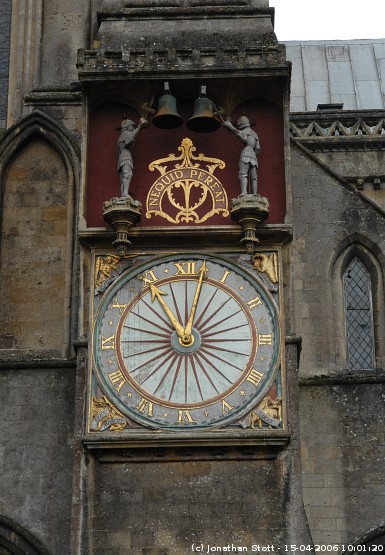
And I had the chance to watch the indoor clock, with its jousting knights, strike the hour of 4:00.
Which reminds me, I was there that late because before heading to the cathedral I stopped at a tea shop in the High Street and lunched on a grilled ham and cheese sandwich and treated myself to a cream tea. And made an indulgent pig of myself and made sure I eked out the scones to justify eating every bit of the clotted cream and every bit of the strawberry preserve and felt no remorse about it, either.
Anyway, at the cathedral. I was able to see the fantastic chapterhouse stairs, and not in entirely bad light. The ensemble looks smaller than it does in the photographs but also not as gloomy. It’s all in golden stone and beautifully patina’d and worn by all those clerics-- and tourists. I had to admit that today we would’ve put in an extra storage closet to take up the excess space left after we’d supplied the canons with a regulation-width stair. And I immediately decided to hell with modern spatial efficiency. It’s delightful as it is, from dozens of different angles.
The chapterhouse, off the stair to the right, is the classic circular kind with a column in the middle and the canons’ seats all round the walls, with their prebends named over them. Though I suppose the existing brass plates are recent replacements. They say they give concerts in there, though not just now as the ceiling is being restored.
The stair goes on up to a corridor leading to the canons’ refectory, still in use these days. In the passage they’ve set up an exhibition of the archaeological history of Wells, including photographs of the bones of bishops they dug up after they’d been buried below the cathedral floor for centuries. This had mostly been done in the last century, by those literal-minded Victorians who couldn’t leave anything to stay put.
Made my pilgrimage to the cathedral shop just before it closed at 5:15. As well as the usual postcards and information booklets I purchased a little devotional book on the Psalms. Something like that might do me good.
Having purchased still more Somerset postcards and a shocking pink highlighter (to mark my actual, as opposed to my proposed, route in my road atlas) at the W. H. Smith’s, I took off northwest along the A371 towards Cheddar.
It was too late in the day to sample any real Cheddar cheese but I could still enjoy the Cheddar Gorge, outside of the town. Leaving aside more spectacular formations that occur in other countries, the Gorge is in itself a spectacular natural feature. You’re tootling along in this nice, innocuous rolling English countryside and then, wham! high rock walls on either side, stretching up to heaven, their fissured sides doing an offbeat undulating dance with the road that goes through between. Not the best weather for seeing the place but at least there weren’t any more tourists around at this time of day. Only locals who can now take it for granted and were probably wondering why they had to get stuck behind the only rubbernecking tourist (me) who was around.
If they do take it for granted they shouldn’t. Somerset is an amazing county.
Crossed the A368 at Barrington and noted the turnoff for Blagdon. That’s where we [our Oxford group of year-abroad students] went to enjoy a cream tea after visiting Bath in March. Picked up the A38 at that crossroads and continued on to Bristol, for the sole purpose of again seeing the Clifton Suspension Bridge. It’s a perfectly wonderful thing, up there over the Avon Gorge.
When I got there I left the car and walked back to the river Avon where I could attempt some pictures, despite the fog.
Then I took the car and tried to get closer, but had a deal of a time finding my way onto the Hotwell Road (that runs by the river) in the first place. I finally did but could find nowhere to stop for quite awhile. Got way north of it, turned around, and finally located a coach stop on the way back. Walked up along the side of the road till the bridge was in sight, now all lit up outlined with white lights in the foggy dusk. The photos are purely experimental, as I doubt my hand-holding was steady enough. And I was trying for some streaky headlight effects at very low shutter speeds.
Maybe I’ll have time to come back tomorrow, and it’ll be nicer.
Meant to catch the M5 at Portishead but instead got on the road to meet it at this side of Weston-super-Mare. One of my wrong turns that came out all right, for a change.
By the time I got the A39 at Bridgwater it was snowing. Not a bad thing in itself but impossible to see the curves without the brights.
As a reward for a long day and not having any stupid accidents on the way, after reaching Holford I took myself to the pub and treated me to a glass of cider. Took it and Uncle Walter to a table in the dining area and drank and read, between listening casually to the conversation filtering over from the bar proper.
One of the men in the group started to sing and another shushed him. Whereupon the singer said, "Dammit, this is a local pub and there’s nobody but us locals here and we can sing if we want to!"
Cannily, Mrs. Ayshford, who was on duty, kept silent about my presence, and several of the jolly company took up some song. Alas, modern culture intervened-- some idiot in the snooker room geared up the juke box-- and Real Music retreated from the field. It was really too bad.
Packed and planned my route for tomorrow before retiring. Tried not to read too late.
____________________________
†Neither my memory nor my trip journal tells me whether I entered the church itself. If it was unlocked and I didn't bother, I am a retrospective idiot. Photos available online show that the Church of St. Mary the Virgin at Holford has some wonderful carving in wood and stone, a delightful little organ, and some lovely work in embroidery and stained glass. Did I think if it didn't sport flying buttresses, it wasn't worth seeing?
Posted by
St. Blogwen
at
12:00 PM
1 comments
Labels: architecture, cathedral, churches, delight, England, food, Great Britain, hillwalking, livestock, local culture, photography, pubs, Somerset, travel, weather, Wells
Wednesday, June 18, 2008
My Great Britannic Adventure, Day Eighteen
Monday, 3 April, 1989
Holford to Minehead to Selworthy to Holford
Day Eighteen
The skies were clouded up again this morning-- yesterday was a special reprieve.
The important thing today was to do the laundry. Mrs. Ayshford directed me to the nearest launderette, seven or eight miles up the road in Williton.
Facility turned out to be on a side street with no parking. No parking anywhere around there. I dumped the car with the hazard lights flashing in a double-yellow-line zone near a driveway outlet across from a store, so I could run in and ask if they knew where I could park the silly thing. Before I got two steps away an old lady of the hard, trousered variety came up and told me I just couldn't leave the car there, that was a no-parking zone.
I told her I knew that but I just needed to know where I could put it.
Well, she didn't care about that, I couldn't leave it there. (It wasn't her driveway, incidentally.)
I'm not sure why but all at once I totally lost it. All the frustration came welling up and I exploded in tears and told her I didn't give a damn and I'd move it in a minute, thank you please, go away and leave me alone.
The clerk in the store suggested a place on the street a couple blocks away and I drove over there. In the end this was all in vain, since the detergent dispenser in the launderette wouldn't accept the coins. This, after I'd walked up to the bank for change (shop wouldn't give me change; no change machine in the laundry).
So I said to hell with this place and drove on to Minehead.
Asked at a Shell station where the launderette was. Ended up driving past both of the ones they recommended and having to ask directions again at an ironmonger's. They were very nice and told me which one was the cheapest, to boot. Left the car where it was and took my backpack full of dirty clothes back down the street with me.
Well. This laundry was definitely cheaper, at 80p a wash, than Williton's. But it had no soap, either. Nothing for it but to shoulder my pack, dirty socks playing peekaboo below the flap, and go down the high street and find a shop to sell me some. Located a discount store and bought the smallest size Persil they had. They didn't give me a sack to put it in, which is typical around here.
So I just brazenly carried it back exposed. It's not like anyone knows me here, after all.
And the machines worked all right, so the clothes were washed and thank God for that.
As long as I was this far west, I decided to continue over to Selworthy, which is a National Trust town. Some people might think it was terminally quaint, but I rather liked it. If Real Life means plastic signs and McDonald's wrappers in the streets, I'm for necrophilia.
I left the car at the carpark up the hill below the church and walked back down, and in and among the houses on Selworthy Green. White walls (cob?), good recent thatch jobs, spring flowers everywhere. Very peaceful. Down along the road there were some bits that looked to be very ancient, like an old stone barn that had been incorporated into a dwelling, but these structures were behind walls and very private.
I especially liked the wooden signs at the crossings of the footpaths, telling how far it was-- by foot-- to the next village. I followed one such path a little way. After a short time I came abreast of a house on whose broad front lawn a small flock of sheep, including several new lambs, were grazing. If these sheep had been told anything about being timid, they weren't heeding it. The ewes especially came up to the fence and bleated and bleated, telling me explicitly that there was going to be no fooling around with their lambs if they could help it. Yes, ma'am!
At the top of the little paved road, where it turns to go past the church and the carpark, was a gate leading to a dirt track and a hiking trail. This led up to Selworthy Beacon. It wasn't far, only a mile or so, so I unhesitatingly passed the gate and headed uphill.
The path goes through a wood and along a little stream for most of its way. But then you come out onto moorland, all clothed with an unfamiliar yellow flowering shrub that looked none too pleasant to wade into.
The path, or more so, the road, continues up to the north until you get to the windy cairn-marked top, the Beacon. On clear days, they say, you can see all the way into Wales. Today with its foggy overcast one could only view Bridgwater Bay, with the great oceangoing ships blending their gray with that of the water.
I couldn't help but think how good it would be to have someone with me now to admire the view, obscured as it was. But would anyone else ever be so impulsively passionate about indiscriminate hill-climbing? I almost wished I could have someone magically transported to the top for me, so I wouldn't feel guilty about making them do the walk, in case they didn't like the view. I tried to picture Nigel* there with me, but it wouldn't fit. Nigel*-and-Emily* would have been a painful redundancy. But Nigel* without Emily* in such a circumstance would be abnormal and anomalous.
There's a National Trust shop down in the village. I bought some Somerset postcards and a jar of elderberry wine jelly. There was also a place that served cream teas but it, alas, was closed Mondays.
I continued in my quest to partake in this most civilised of ceremonies when I returned to Holford. But there, too, the shop across from the cottage only kept their tea shop counter open till 5:00, and it was just past that now.
Braving the rather brisk wind in my tweed blazer, I walked up the road into the depths of the village, as far as the lychgate of the church. Very pretty and worth more exploration when the wind and I can meet on more equal terms.
Took the evening off, spending most of it in the downstairs parlour (marginally warmer than the room). Watched the 6:00 o'clock news but most wrote postcards and journal and read Walter Scott.
I asked Mrs. Ayshford about the heat. She said, well, she supposed they're country people and just don't mind the cold. So, she said, having a heater in the guest room just never occurred to them. It seemed unlikely to do so now and I decided, at £8 a night, what do you expect? I can perfectly well survive by wearing my longies under my flannel nightgown and keeping as much of me as possible under the two duvets . . .
Posted by
St. Blogwen
at
11:49 AM
1 comments
Labels: bed and breakfast, clothes, England, frustration, Great Britain, hillwalking, houses, livestock, Somerset, travel, weather
Sunday, June 15, 2008
My Great Britannic Adventure, Day Seventeen
Sunday, 2 April, 1989
Holford to Taunton to Glastonbury to Wells to Holford again
Day Seventeen
Had breakfast at 8:30, down in the sitting room. The family’s black and white border collie named Roly came in and begged with his big brown eyes, but had no better luck than his predecessors. When Mrs. Ayshford discovered it she hauled him away. Which was too bad, as I liked the company.
Taunton was my first stop today. Took an unclassified one and a half lane road from the A39 south to Crowcombe. Very pleasant, tree-lined, with little traffic. It was actually turning out sunny and there was a place to pull off and shoot pictures, looking towards Bridgwater Bay.
After Crowcombe it was the A358 into Taunton. Devil of a time finding a place to park, till it occurred to me I could put the car on the street, it being Sunday.
First visit, to the church of St. Mary Magdalene near the center of town. But I'd diddled around too much if I'd expected to attend services there. Church was at 10:15 or so and I got there at nearly 12:00.
I guess there was some advantage to having the building to myself to explore and take pictures of. It's a very nice 15th Century Perp church. The ceiling, recently repainted black with all sorts of green and white shields and gilded angels, is stunning. Lots of fine sculpture in the double aisles. Rather odd terrarium-looking altar, though. Unique is the word.
Also very nice pierced decoration on the tower.
Wandered around town trying to find a phonecard box. Located one near the river and called down to Kent to a B&B there that looked interesting. So I have a place for Thursday night. And I called Phyllis Johnson* in London and asked please could I stay there Wednesday after coming to hear [Hector Berlioz'] Romeo & Juliet that night. Oh, yes.
So, very good-- except that I couldn’t get my card out of the phone. Called the British TeleCom toll-free repair number. All the man could suggest is leaving the card there and having them send me a new one. But I needed it back now! Luckily, it popped back out even as we spoke.
The blue and white bridge over the River Tone looked so pretty in the sunlight that I walked down a ways, past the castle, to see it better. Watched the ducks on the water and the clouds in the sky. The castle was converted to a high class hotel ages ago [not entirely true, I now find; part of it is the Somerset County Museum], but you can walk along the river in the castle gardens. There were some large bushes growing there, with bright yellow flowers growing all over them like cheerful pompoms. I've never seen a shrub like it before. I wonder what it is? I like it.
Tramped around trying to find something to drink. Settled for a bottle of ersatz raspberry fizz water at 20p at a formica-topped cafe. Definitely an Experience.
I passed through one street down by the church and noticed how packed it was with artsy-craftsy supply shops. All those pipe cleaners and beady glue-on eyes, and for what? And it hit me what a reprehensible waste all that is. How can people have such trash in their homes, and pay good money for it, too, and spend good time and money making such things? I realize most people don’t feel such moral repulsion against it, but it is hard to wonder why something that seems so painfully obvious to you shouldn’t be apparent to everyone else.
Walked north of the river only as fair as the railroad station. After that, I took off for Glastonbury like a good little architectural tourist.
Up the A361, not too many miles from Taunton, I saw something that looked an awful lot like Glastonbury Tor but on closer inspection was not. It was a ruined chapel dedicated to St. Michael on top of a mound called the Burrow Mump, near Othery. And of course I had to double back, park the car, and climb up.
Other people had the same idea. Families and couples out in the sunshine. Great view of the Somerset Levels and all the little towns below.
That done, I came down and drove the rest of the way to Glastonbury. And wondered how I could’ve been mistaken about the Tor, once I’d seen the real thing in the distance.
Found a carpark (free on Sundays) not far from the town center and walked to the Abbey. Could get a little weird there, since not only was Glastonbury a great Benedictine center, but because of the Arthurian connection, various New Agers and other fringies find it an attractive pilgrimage spot as well. Several shops on the High Street for me to stay out of, though for the most part it seemed pretty laughable.
Judging from the size and compass of the ruins, Glastonbury Abbey when complete must’ve been a jaw-dropper. Just incredibly huge. Very Norman in feel, even in its Gothic parts. Lots of dogtooth ornament. And some original floor tiles left, in situ. You look at them by lifting up wooden covers. They’re all below existing ground level, which is higher than that of four hundred years ago.
Funny thing, though. Durham Cathedral is older than Glastonbury; the building is, at least. But Durham doesn't seem so incredibly remote and ancient as Glastonbury does. Maybe it's because here it's all ruins, so the place is arrested in the past. Up in Durham, the cathedral is used and lived in, as it were, and it's part of the everyday life of the Christian church-- regardless of its current bishop! So Durham belongs to Today, old as it is. There I got a sense of fruitful rootedness and living tradition. But here-- whatever's living is living several centuries back, and it pulls you into a world that is a long time ago and culturally, at least, very far away.
Which would explain the airhead-looking types sitting around soaking up vibes from the stones (what the sensible Benedictines would’ve said, I can’t think). There was one man, Western but with hair, beard, and robes like an Indian guru, sitting meditating in what was once the chancel. I considered taking his picture but decided it’d be a poor idea. If I showed such a thing, my audience might think I approved, which would be bad, or know I was holding the man up to ridicule, which would be worse. As much as I may deplore his creed I have no right to compromise his dignity.
I do have to wonder how much of this New Age business would be going on here if the Abbey were still an intact, functioning church. I mean, how much of this myth and legend stuff is us modern people putting our ideas on the Past, which isn't still around to defend itself?
Wandered around the grassy grounds contemplating the trees and flowering shrubs, including what is supposed to be a scion of the original Glastonbury Thorn. I used to love that story of Joseph of Arimathea planting his staff in the soil here-- did I ever actually believe it, or just want to, like the story of Santa Claus?
Visited the abbot’s kitchen, the only building really left intact. It was used as a Quaker meeting house for awhile. I was disappointed to see how some idiot had defaced the exhibits with vulgar writings and drawings. Real grown up, turkey.
Drove round to the Tor, but wasn’t so good at following the signs. But that was all right, since the road where I ended up got me closer to the stile to one of the footpaths than the official parking lot would’ve. Left the car at the side of the street and headed up the hill.
It is a big hill. The best way to climb it is to go round the curve, though I trusted my shoes enough to risk taking sideways steps diagonally up the grass. Wasn’t wet by now, fortunately. The clear, dry weather was holding beautifully.
The ruined chapel here, too, was dedicated to St. Michael. He seems to get the ones mounted up on pinnacles, doesn’t he? Like the one at Burrow Mump, this place was also thoroughly betouristed, with couples lying or wrestling around on the grass and children running in and out of the remaining tower. You just have to accept it and appreciate it for how it is, even if you’d prefer it quiet and to yourself.
The pagans, literally, had been at the place, scribbling their graffiti over a plaque, claiming the hill as their personal free-love site for some dark celebration . . . I don’t see St. Michael being too thrilled with that-- let alone, God.
From the top you can see all over that part of Somerset-- down to Glastonbury, the black and white cows grazing in the fields, and northeast all the way to Wells, its cathedral readily apparent. The sun was dropping lower, its light becoming more golden, backlighting the grasses of the hillside.
I came down a different way, meaning I continued my original counterclockwise progress all round the tor till I came down again to the stile I’d originally crossed. There were sheep even on this touristed mound, and little lambs ramming and butting one another, or running away behind their mothers if anyone got too close.
Back to the vehicle, then down to the town again, and caught the A39 up to Wells.
When I’d parked the care there in Sadler Street, opposite the gate, it was just on 6:00 o’clock and the cathedral was closing. I went in anyway, just for a minute.
And you know, there’s a wonderful effect that you get looking squarely down the nave: The line of the foliated capitals of the shafts of the clerestory lead your eye swiftly down the righthand side, swooping down the downward curve of the upper, inverted strainer arch, up its upward counterpart to the left, then flying back towards you along the lefthand row of clerestory capitals. Incredibly dynamic. You feel you can see the forces go. It all works a lot better than I’d thought.
And of course the carving in the capitals, above and below, is worth seeing for itself. So marvellously crisp (I hope it’s not all 19th Century restorations).
Having plenty of time in this part of England, I didn’t push things here today. But one thing was important, that I felt called to do. I passed up to the front of the nave, just before the Communion rail, and asked God that if-- no, when I come to forgive Lukas* for his behaviour at Iona (for he must be forgiven, else I’ll suppress this and it will only add to my general sickness of soul), I will truly forgive him, honestly and completely, and not keep pulling his offense out again, to his hurt or to my own. The thing must be made right between us, it must.
There was a young clergyman locking up, so I just verified that the Chapter House would be open tomorrow, and allowed myself to be shepherded out with some other stragglers.
I did not leave the cathedral grounds then, not a bit of it. The sun was striking full on the west facade and also illumining the north flank. And you know me-- I like anything with the sun on it. I think I killed a whole roll of film just on the Wells exterior. They’ve been cleaning the masonry and it all looked golden and lovely. I had good fun shooting the high-up statuary with the telephoto. They’re what that facade is all about. The doors themselves are ridiculously insignificant.
I was still there to see the funny clock on the north side mark 6:45. Then I got an ice cream (loosely-speaking) from a vending lorry and wandered out and back in to see the grounds of the Bishop’s Palace.
It was closed, but the moat and walls with the swans and ducks gliding by below could all be seen in the most welcome and fortuitous light. The mallards are wonderful, the way the color of their shimmering neck feathers changes from royal blue to grass green to velvet black and back to teal again, depending on the angle of refraction.
You can go in the gateway of the palace and look into the inner court, but no farther except for one or two days a week, when there are tours. The Bishop still lives there. I tried to imagine one of the Coverdale* guys rising to this estate. Somehow I can’t picture any of them feeling comfortable in such splendour.
It was proper time to head back to Holford by now, being well past 7:30. Trouble was, my petrol gauge was riding on empty and here it was Sunday evening. I’d seen an Amoco station selling 4-star at £1.76 a gallon (miracle!) on the road above Bridgwater last night, but now I had no idea exactly where it was or if it was even open. Just what I needed, to run out of petrol. I didn’t help myself by getting onto the wrong road out of Wells and wasting fuel going all the way to Wookey Hole before I realized my error. Back and got onto the A3139 as planned, west towards Highbridge. Coasted as much as I could. I don’t know how much reserve this car has when the needle’s on empty, but I wasn’t taking chances.
Came out onto the A38 and after a bit came to a British Petroleum garage that was open. Damn, £1.87/gallon-- but read the old one about beggars and choosers as said. How nice then to pull away from there with a full tank and spot the Amoco a few miles closer to Bridgwater-- and open.
Proper good sunset this evening, but it was quite dark as I again drove the curving road towards Holford. All sorts of fun with the brights, trying to see how long I could keep them on before having to dim them for an oncoming driver. It’s near impossible to negotiate that road on the low lamps, especially if you’re trying to go as fast as local expectations would have it.
Decided since, except for the ice cream and that raspberry fizz, I hadn’t eaten since breakfast, I’d pop over to the pub and have a meal and a glass of Somerset cider. The barbecued chicken was the least expensive, and came with a jacket potato, mushrooms, and peas, for about £3.45. Glass of medium-sweet (but hard) cider for 52p. Brought Walter Scott [Heart of Mid-Lothian] along to keep me company, though the cover of that Everyman Edition doesn’t take kindly to being propped up on tables.
There were several other people in the Plough, including a group of people in their 20s. The guys were making some rather rude suggestions to the girls, which struck the young ladies as more funny and provocative than repulsive . . . It made me think about cultural differences-- not national, but class-related. But maybe it has more to do with religion. I couldn’t imagine any of the guys in the young adult class at my home church or in Coverdale* making personal comments about a female friend’s private anatomy to her face. I couldn't imagine them making such comments at all! Here and now over supper, I decided that as long as these people didn’t attempt to draw me in, I was going to ignore it and not let it make me nervous.
Returned next door to my room at around 10:00 and vegetated with the book until turning in.
Posted by
St. Blogwen
at
4:55 PM
2
comments
Labels: architecture, bed and breakfast, cathedral, churches, delight, dog, driving, England, gardens, Glastonbury, livestock, local culture, pubs, Somerset, Taunton, Wells