Friday, 7 April, 1989
Moatenden to Great Dixter to Bodiam to Hastings to Oxford
Day Twenty-two
Breakfast was in the big, low-beamed kitchen. Last night Mrs. Deane showed me one of the ceiling beams that some archaeologist was specifically interested in, as to its antiquity and date. Going from Cecil Hewitt I would’ve thought the original structure was rather different from what this other man had surmised, but then I’m just a novice at this sort of thing.
I’m afraid I was rather behind getting to the meal. But Mrs. Deane was quite cheerful about getting me my eggs on her big Aga-- after all, her son had just come in to eat, too; thereafter to help deal with some workmen who were expected in.
The Londoners were finishing their holiday today, too-- their daughter’s school was restarting soon. We all traded horror stories about driving in London, and then Mrs. Deane invited us to walk about in the garden, if we would, before we left.
Sadly, it’s still rather awry from the big storm in October of ‘87. She hasn’t been able to get the tree surgeons in to deal with all the broken limbs. And a lot of the plantings besides those trees were destroyed.
Still, it was nice to walk to the back of the garden and contemplate the daffodils beside the watercourse. Funny, but Mrs. Deane told me that the moat that gives the Priory its name was originally a dry one. Moatenden Farm, just across the moat to the north (and a separate property) has oast houses. Be fun to see inside one sometime.
Picked my way round to the front, to get a view of the 12th century bit in front. It’s mainly just the doorframe and so forth at the kitchen end-- the brick nogging dates, I’d say, from the late 1500s, early 1600s.
After I got my things together upstairs, I sat down and wrote postcards. That done, I settled accounts, loaded the car for the last time, then drove away south. Stopped in Headcorn, where I posted the cards. Great fun--it started raining, hard, as I dashed back to the car-- then just as quickly stopped again.
I thought of heading generally northwest, meeting up with the M25, then catching the M40 straight back to Oxford. That’d certainly get me there by car-turn-in time at 4:15. But it seemed rather dreary, and anyway the rate the M25 goes, I wasn’t so sure it’d be all that quick. Besides, I had a hankering to see the sea again, feeling I mightn’t get another chance while I’m over here. So on to the south it was.
I’d read somewhere that Great Dixter doesn’t open on weekdays till the end of May, but just for jollies I followed the lane to it when I hit Northiam, just to see.
Well, it is open weekdays, but not till 2:00 PM. Oh. Only 11:00 now. That’d mean another day’s car hire. Oh, well.
The man in the nursery, which was open, pointed out Bodiam Castle which you could just see on the horizon to the west, only about four miles away.
Well, why not?
So I followed the little lanes down and around and soon was there.
Bodiam Castle is such an odd little thing, especially after places like Warkworth and Caernarfon. It obviously meant business, sitting there so solidly in its wide moat. But still you get the impression of a small swaggering person who defies people to attack him. One backs off, just in case, but one is still left wondering if one’s leg is being pulled all along.
Worked my way round the moat counterclockwise, as the sun dove in and out of the clouds, till I reached the main entrance. Other visitors were going in and I decided that if admission was free, I’d look in. But if not, I hadn’t the time.
It was 90p. OK! It’s off again we are.
Wended along over to the A229, heading for Hastings. In Hastings the main roads don’t indulge in any such American nonsense as a bypass. No, the A229 went straight down to the seaside. There you pick up the A259 which runs parallel to the water, with the big hotels on one’s right.
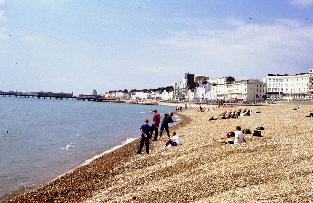
The sea was in magnificent form today, sending great towers of spray over the sea wall and onto the windshield of the car where I’d pulled it over to get out and see. The waves thundered gloriously and I was sorry I had to be on my way so soon.
Decided to take the seaside road as much as I could. Went through Brighton, where I could glimpse the Royal Pavilion, freshly restored, I am told, on the right. And Shoreham by Sea, and on to Worthing.
It was there that I knew I’d have to give up my plan, for although it’s nowhere near high season a plethora of other trippers had the same idea I did, apparently. The sea road was incredibly clogged and slow. I made it partway through Worthing when, considering how shockingly fast time was getting on, I backtracked a ways then got myself onto the A27, a bit to the north.
That was much faster-- it even has dual carriageways in places-- and except for lacking the view of the Channel was just as pretty. I love so much to see the sheep on the sunlit green hillsides! It’s as if so many fluffy white flowers had sprung up and blossomed in the space of a night. And the view coming down the incline into Arundel is simply breathtaking. The castle and cathedral were bathed in light, made much more dramatic by the clouds gathering to the northwest.
Again, though, no time to stop-- I had to press on.
Not that I didn’t pull over a bit farther on-- I stopped and got out to take photos of the thunderheads piling up over the downs-- they looked so Midwestern!
As I entered Portsmouth, around 2:15, I saw that the needle on the petrol gauge was riding rather low. I started to look for a Shell station, figuring that since everyone’s gas is overpriced here I might as well patronise the oil barons my mother works for. And soon I spotted one-- on the far side of the divided road that the A27 becomes as it passes through the northern regions of the town. But there were no legal right turnings I could see for blocks and blocks.
So at next opportunity I made a left into a residential neighborhood, then another, then another, round the block hoping to find a cross street that’d intersect with the highway and allow me to backtrack to the filling station.
As I was on the northward leg of this square I passed a cyclist, giving him plenty of berth. At the end of the block I could see, as I approached, that the way ahead was blocked-- there was indeed a bridge over a stream or ditch, but closely-spaced bollards closed it to motor traffic.
Well, rot. I put on my turn signal in good time and when I reached the T-junction, turned left yet again.
All at once, I heard a bump on my left rear fender. A cry came from the road behind me, more of wrath than of pain. Chilled with apprehension, I stopped the car and looked back-- to see the cyclist lying on the ground just short of the intersection, his supine bicycle spinning its wheels beside him.
Well, you know me, especially when I’m tired and hungry and rather frightened besides. I ran back to the corner, grateful to see him getting to his feet, and said, "Oh, I’m so sorry! I didn’t see you! I’m so sorry! Are you hurt?"
The cyclist, a rather regimented-looking young man of about twenty-seven or so dressed in a BritRail messenger’s uniform, flexed his ankle and said, "Well, I suppose it’s all right," adding accusingly, "no thanks to you."
I went off on another volley of apologies and blametaking and he was well-satisfied to give me a grim little lecture on the rights of cyclists and the rules of the road. It was so shame-making-- for as one who for years got around mostly by bike, who should know such things better than I?
Then he got out his walkie-talkie, with another comment about how it wasn’t my fault that it wasn’t broken, and radioed his office, giving them the license plate number of the hire car and my driver’s license number and all the rest of it.
Immediately fears of horrendous lawsuits swarmed into my head-- maybe I wouldn’t be allowed to leave England. And whatever would the EuropCar people say?
Finally, as if he were a traffic cop and not an accident victim, he sent me on my way, saying cynically, "Next time you run down a cyclist, try a little harder-- maybe you’ll do a better job of it"-- as if I’d gone after him on purpose.
I found the way to the Shell station and got a fill up and a chocolate bar. I wondered morosely and guiltily what the attendants would say if they knew what I’d just done.
Continued on into Southampton, where I got a little lost trying to hook up with the A34 going north. It was around 3:00 by now and the primary schools, with all their uniformed scholars, were letting out. This forced me to take it specially slow-- another accident I did not need.
After I got on the A34 and up past Winchester, my head began to clear a bit and I got to wondering. How could that accident have been my fault, since he was the one who’d hit me, presumably as I’d turned the corner? And how, since I’d passed him about even with the previous cross street, had he managed to come up on me so fast, and why? And considering that I’d signalled for a left and the way ahead was blocked, how could he for a moment have thought that I wasn’t going to turn left, or have been such an idiot as to think he could pass me before I did? For afterwards he’d gone off straight ahead across the bollarded bridge.
And in place of my fear and guilt came a swell of anger-- anger at people who can so cleverly blame others for their own foolishness and at myself for habitually being such a patsy for that sort of person.
The day and my mood rapidly deteriorated as, short of Newbury, I came upon a backup that the radio said stretched out for ten miles and for which their traffic reporters would propose no explanation. All I knew was that it took a half hour to go five miles and my chances of making it to Oxford by 4:15 were to hell and gone.
When I got to Newbury, I discovered the problem-- It was simply the glut of Friday travellers and commuters taking their turns getting through the Newbury roundabout. Damn this road system! Haven’t these people heard of a proper interchange?
Thank God the road was clear after that.
I’d planned to reenter Oxford by the eastern bypass, by way of Littlemore and Cowley, but saw there was no way. It was 5:00 already and the hire office closed at 5:30. So I came up the West, got off onto the Botley Road, and wended my way through the rush hour traffic by way of Beaumont Street, finally reaching Banbury Road and Coverdale*.
Fast as I could, I emptied out the car, dumping my luggage in the basement flat [where I had been moved during the vac]. That done, I dashed back across the Chapel passage and back to the car.
Fought off the Oxford traffic back to the Botley Road. There I perpetrated an act that put the crown of absurdity on this whole confounded trip-- I mistook, or misremembered, the way into the carpark for the shopping center where the hire place is. Instead I found myself on the highway on-ramp and thence heading southbound back down the A34.
I didn’t care who heard me, I screamed in frustration! In an access of self-disgust, not to say self-destructiveness, I gunned the engine and as my speed mounted I didn’t give a holy damn if I were arrested for speeding or cracked up the car or committed whatever other mayhem.
But I couldn’t help but see the Palm Sunday cross that’d been hanging from the rearview mirror ever since Saffron Walden. And a more sensible voice reminded me of what a bad witness it’d be if I did something foolish with that present to proclaim me a Christian. Chastened, but still very upset, I slowed down and turned left into what I discover is Yarnells Road. This took me to North Hinksey Lane and back to the Botley Road.
This time, I didn’t miss the turning to the car park. And thank God, though it was 5:40 the EuropCar office was still open. I told them about the cyclist and filled out a report on the smashed door I so cleverly acquired in Stamford. The girl at the counter agreed that my second-thoughts version of the encounter in Portsmouth was probably the accurate one. She told me not to worry, they’d take care of it, since it was properly reported to them and she’d taken the particulars down from me in writing.
I couldn’t get my deposit back yet, as all the cash was locked up for the weekend. And I nearly forgot my Palm Sunday cross, running back to retrieve it.
I did not take a bus back to Oxford. I’d had enough of vehicles for quite awhile. Instead I loitered along the Botley Road, pausing to inspect the little ramifications of the Thames as they passed under each bridge I crossed. I stopped to see the locks at the Osney Bridge, coming down into East Street for a closer view. At one point, I passed a young guy who was trying to hitch a lift into Oxford. I nearly laughed in amusement as I told him, upon his inquiry, that the city was only a short distance ahead-- he’d might as well walk. Everything was bathed in a golden western light and as calm returned I felt a great sense of proprietary affection for my city as it appeared ahead.
And so to New Road, round by the castle mound, and thus by Queen Street to Carfax. It was a little short of 7:00 and I just had time to pop into the Coop on Cornmarket for some milk and other supplies.
Thus provisioned, I strolled up Magdalen, up St. Giles, and finally to the Banbury Road and Coverdale College*.
I’ve been utterly useless the rest of this evening. I made myself supper and took forever eating it at the desk in the little bedroom down here. And, ignoring the luggage that wants to be unpacked, I’ve finished reading Scott’s Heart of Mid-Lothian (and rot him, need he be so predictably moralistic in the end?).
The college is still overrun with those absurdly embarrassing students from Bemidji, Minnesota, and I still don’t know how I shall deal with the problem between Lukas* and me. But away with all that for now-- I’m back at Coverdale*, thank God, I’m home at last, I’m home!
Monday, October 20, 2008
My Great Britannic Adventure, Day Twenty-two
Posted by
St. Blogwen
at
9:00 AM
2
comments
Labels: accident, architecture, bed and breakfast, bloodymindedness, castle, delight, driving, England, frustration, gardens, Great Britain, history, Kent, livestock, Oxford, photography, weather, woe
Wednesday, September 17, 2008
My Great Britannic Adventure, Day Twenty-One
Thursday, 6 April, 1989
London to Rochester to Canterbury to Moatenden (Kent)
Day Twenty-one
Got up and dressed in time to go feed the meter a pound or two. That was only good for an hour but that’s all the meter will give you in the daytime.
Phyllis* was already gone to her job but one or two of the roommates was rattling around. Didn’t see any of them, though.
Made myself some breakfast then got out of there, bag and baggage, around 9:00. Did not want a ticket.
I’d made no particular plans for today, but I thought I’d like to see Westminster Hall. So I muddled through the very slow London traffic, figuring I’d get down to the Parliament buildings and check out the parking and take things from there. But when I hit Parliament Square the sidewalks were lined with people behind barricades and bobbies everywhere. Parking situation didn’t look hopeful enough to even mess with. So I took the Lambeth Bridge south then started looking for the A2 to Canterbury.
This morning I took a version of Phyllis’* advice of last night. I spotted a coach with a Kent logo on it and followed it. Although the way to the A2 was fairly well marked, staying in the wake of that light green coach made things a lot easier.
I was well into the suburbs when I heard on the radio that all the hooha in Westminster was because Mikhail Gorbachev was in town today, Raisa in tow. Another good reason to skip town. That could’ve been a zoo.
The signs for Rochester came along just before the junction of the A2 with the M2. I decided what the heck, as Dr. Gendle [my Oxford medieval architecture history tutor] says the castle’s worth seeing, I might as well look it over as long as I’m here.
You go through a town called Strood first, then across a good big stretch of the River Medway, before you get into Rochester proper. The downtown is still pretty old looking but they obviously do a good deal by way of shipping. I parked the car on the street under the castle wall, opposite a marina.
The light meter on the Minolta is definitely screwy. The ring on the lens is stuck and the lollipop and stick never line up. So first item on the agenda was to find a camera store on High Street and get it checked.
The man there says the meter’s fine, if you disregard the fact that the f-stop ring on the lens is stuck. I nearly let him sell me a used exposure meter but the thought of having to fiddle with it was too tedious. Besides, I’ll see about getting the camera fixed in Oxford, this weekend. Did get a typical reading for today’s cloudy conditions and that’ll have to do. You’d think that after fifteen years of using that lens I’d be able to set it without the meter, anyway.
Well, we’ll see.
Another thing-- the camera’s case smells like beer. That’s strange, because I didn’t have it in the pub with me Tuesday night.
It was mizzling a bit when I got back to the castle. Came in by way of King John’s round turret, or rather, through the encircling wall to the left of it. The castle entrance is up some modern steps to the forebuilding. Inside you meet the admission desk and the postcard concession. Your tariff paid, you turn right to go into the castle proper-- though it’s more like going outside, since the hall and solar are now roofless all the way up.
The circulation is all around the perimeter, with stairways in the corner towers. Kept having to remind myself that the stairs wouldn’t’ve been so precariously worn in the 11th and 12th Centuries. But still, the old owners had a fine disregard for the niceties, like railings and uniform riser heights, considered so necessary by 20th Century American housing codes. The National Trust has supplied the railings, but some of them were wet with paint today. It was really too bad for some of the other visitors, such as some women wearing medium-heeled shoes. With my suede waffle-stompers I was fine.
The central wall is still there, of course. I’m trying to remember if one of the shafts in it was a rudimentary sort of dumbwaiter, or if that was just the loo. Pretty fancy loo, if so.
The castle also has some nicely-carved fireplaces for the various chambers. All very up to date and civilised, for the time.
They’ve built a new roof, with a skylight, over the chapel, which is in the upper storey of the forebuilding. It looked better-preserved than the rest of the castle. It got me thinking about the religious attitudes of the old inhabitants-- were they sincere Christians or just using God (like so many of us do) as an endorser of their own plans and prejudices--in their case, the making of war on their neighbors? From our pacifistic perspective it’s easy to think the latter, but who are we to judge?
Could’ve done with less rain today. Used the flash a lot, which overcame some of the meter problems. Deliberately set it low to preserve some of the effects of the subdued lighting.
After the purchase of two or three postcards, I went out and took a look at the remainder of the castle grounds. There’s a very fine dogtooth-moulded Norman archway to the northwest-- except that it’s a restoration. I feel so ambivalent about that.
Skipped the cathedral-- no time to satisfy mere curiosity-- and returned to the High Street in search of something portable to eat. This town turned out to be remarkably short on fruit stands, which is what I really wanted. But I got a box of shortening biscuits from a grocers and a couple of disgustingly greasy pastries called Eccles cakes from a bakery and returned, dripping crumbs, to the car.
Took off at around 1:00. Tried to be creative on my route out of Rochester but I only succeeded in getting myself sequestered down a potholed, dead end lane. Back across the bridge across the Medway and through Strood, then.
Listened on the radio to the effusions of enthusiasm for Gorby and company that were coming out of London. I can’t believe the simplemindedness of some people. They probably think Mrs. Thatcher’s a spoilsport because she advises caution.
Back on the M2 and thereby to Canterbury. Cute town, lots left of the ancient city wall. But with all those generations of pilgrims and tourists you’d think they could do better regarding parking. I drove round and round and round, literally, before I found a carpark that had spaces, let alone one that was affordable. And we were talking 40p per half hour, at that.
Anyway, ditched the Astra and threaded my way though a pedestrian mall in the city center and eventually found myself at the Cathedral.
More scaffolding, lots of tourists. Expected by now, and at least it wasn’t high season.
Entered by way of the southwest porch. But I couldn’t hang about contemplating the nave, as one is required to purchase a photography permit. You get that at a little bookstall in the southwest transept. So I made my way there first.
After that, I passed between the parish altar and the massive choir screen to the northwest transept, to where it all happened in 1170.
It’s a little daunting to consider that-- there’s no doubt of it whatsoever-- in this very spot St. Thomas á Becket was murdered. And whatever you may think about the relative merits of his case and of Henry’s, there’s still the fact that Thomas was upholding as best he knew the will of God. There’s an immediacy about being there, even after these long centuries, enhanced by the evocative modern sculpture, a cross formed of two jagged swords and their scabbards, set above the altar. And behind you is the cloister door through which the four knights entered . . . Kyrie eleison!
There was also a plaque commemorating the occasion on which Pope John Paul II and Archbishop Runcie prayed there together. Very sweet and ecumenical, what?
Took the stairs down to the crypt, with its chapel and treasury. There’s a sign reminding people that that’s still part of the church, but some boys down there hadn’t got the idea. I refrained from adding my admonishments to the noise, though.
Quickly scanned the display of church plate then reëmerged back up around in the southwest transept. Being limited as to time I didn’t spend much time in the choir, rather I crossed quickly again northwards and climbed the aisle steps to the Trinity Chapel. They’re a big flight of them, but I decided that if all those people for all those centuries could make it up without complaining so could I. It was piquant to think I was making my own Canterbury pilgrimage, anyway. I liked the sense of heritage.
The glass in the Trinity Chapel is absolutely brilliant, in any way you use the word. God, those glaziers know what they were doing! 17th Century Flemish stuff is cut and paste in comparison.
While I was contemplating the Becket miracle windows the PA system came on and a man’s voice welcomed the visitors to the cathedral. It also reminded everyone that this is not only a tourist attraction but also a house of worship and prayer. After informing us when the evening service was to be, the voice requested everyone to please bow their heads for the Lord’s Prayer. I knew there were a lot of French tourists about today-- there always are, lately-- and I wondered if they’d know what was going on.
Apparently so, because although not everyone seemed actually to be praying, the noise level, blessedly, went down.
I wonder who that was on the PA. Robert Runcie himself? No, probably not . . .
I passed around then and stood before the spot where Becket’s tomb once stood. There’s nothing left of it now-- Henry VIII and his successors made sure of that. But still, at the site of the final earthly lodging of a determined and visionary cleric I was moved to pray for the ministers soon to come out of Coverdale College*, for their ministries and vocations, and especially for Nigel’s* . . . O sancte Thoma, ora pro vobis!
To the east is the Corona with its altar-- it’s roped off so you must survey the glass there from a respectful distance. The Jesse Tree window is there.
I came back round via the south aisle of the Trinity Chapel; I was disappointed to see that both St. Anselm’s and St. Andrew’s Chapels, pre-Becket parts of the Cathedral, weren’t open to visitors. But as long as I was now back on the north side, I popped out to see the cloisters. They’re elaborately fan-vaulted, and ornamented with everybody’s and everyone’s shields and arms.
The Cathedral bookstall, in the southwest transept, didn’t have as many nice postcards as I would have wanted. Still, I purchased one or two and was reminded at any rate to go visit the West Window with its image of Adam delving, before I departed. It’s some of the most ancient glass here.
Couldn’t stay much longer, though: I was afraid of getting a parking ticket. But I did pop into a souvenir shop on the High Street and got more postcards and a nicer Cathedral guidebook than they had in the church itself.
One thing they didn’t have was a copy of The Canterbury Tales in the original Middle English. Nothing but modern. If it could be done with sufficient economy, it’d be neat to have an edition that was dual-language, with illuminations.
Got back to the carpark by 4:30 or so; no ticket, thank God. Got out onto the A28 and headed southwest.
I really love the names of the towns in this place! Between Canterbury and Ashford there’s actually a town called "Old Wives"! Is that the original site of the original tales?
Got the A262 then the A274 and began to look for Mrs. Deane’s guidemarks for Moatenden Priory-- except for doing it the other way round: she’d assumed I’d be coming from the north. They were good directions and I spotted the turn-off just fine. But as I wasn’t expected till 7:30 and it wasn’t even 6:00, I overshot it on purpose and drove up to Sutton Valence to see what I could do about dinner.
Not much, there. I stopped into the local pub. They weren’t serving proper dinners yet, since the cook wouldn’t be in till 6:30 or so. But I could have a beef burger for around six quid. What is this, London or something? I declined and drove down the lane to Chart Sutton. But the pub there wasn’t open yet at all.
Oh well! So I’ll be early!
Mrs. Deane, the white-haired lady who owns Moatenden Priory, didn’t seem to mind. She showed me up some narrow steps to a good sized room overlooking the back garden. It had a fireplace (plugged up, unfortunately), nice dark-wood furniture (including a glass-fronted case full of books), and two twin beds, one of which had a coverlet of patchwork deerskin, with the hair still on. The other had a synthetic thing that was more or less supposed to match it, in a fake fur sort of way.
The other people staying here, a couple from London and their grown daughter, pulled in before I could get my things out of the car. It was a pity, because otherwise I could’ve moved mine and got an unobstructed photo of the front of the house-- part of it is 12th Century.
All day I’d been wondering why the back of my Minolta smelled of beer-- and now I found out why: The lid of the jug of cider I got in Taunton yesterday morning was loose. Oh, boy, are the EuropCar people ever going to love me!
Mrs. Deane suggested I try Headcorn for supper. I’d decided that since it was my last night out I’d splurge on one. The people in the local there were rather friendlier and the prices weren’t so ridiculous. I still had to wait for the cook to arrive, though, so I retired to a table with a half pint of ale and Walter Scott and sat back to observe the goings on.
It was rather different from the Plough in Somerset. The people here came filtering in wearing jackets and ties-- good chance they’d just finished a commute from London. And when one bloke pulled out a portable phone and made a call, I almost burst out laughing, it was so incongruous. Because for all that, it still was a basic British pub, with kids running in and out (the boy may’ve belonged to the landlord) and the usual decor, enhanced in this case by airplane memorabilia.
I ordered roast beef with peas and potatoes and was glad to get it, too. Can’t get it at Coverdale*.
Back at Moatenden, I sat down in the little white painted hall reading in front of its great fireplace and making faces at the little dogs that trotted in and out. That fireplace is taller than I am-- I could’ve walked right into it. The fire on its bed of ashes and coals occupied one corner-- you could just imagine pulling a chair into the other side of it.
I didn’t see any other of the company while I was there; I retired to bed around 9:30. I decided, even though I’d been sitting on the bed with the fake fleece coverlet, to sleep on the other one-- one doesn’t often get a chance to slumber under deerskin and I doubted I’d ever have such again.
Posted by
St. Blogwen
at
3:29 PM
4
comments
Labels: architecture, bed and breakfast, camera, Canterbury, castle, cathedral, delight, driving, England, food, Great Britain, history, Kent, London, Middle Ages, photography, pubs, Rochester
Wednesday, June 18, 2008
My Great Britannic Adventure, Day Eighteen
Monday, 3 April, 1989
Holford to Minehead to Selworthy to Holford
Day Eighteen
The skies were clouded up again this morning-- yesterday was a special reprieve.
The important thing today was to do the laundry. Mrs. Ayshford directed me to the nearest launderette, seven or eight miles up the road in Williton.
Facility turned out to be on a side street with no parking. No parking anywhere around there. I dumped the car with the hazard lights flashing in a double-yellow-line zone near a driveway outlet across from a store, so I could run in and ask if they knew where I could park the silly thing. Before I got two steps away an old lady of the hard, trousered variety came up and told me I just couldn't leave the car there, that was a no-parking zone.
I told her I knew that but I just needed to know where I could put it.
Well, she didn't care about that, I couldn't leave it there. (It wasn't her driveway, incidentally.)
I'm not sure why but all at once I totally lost it. All the frustration came welling up and I exploded in tears and told her I didn't give a damn and I'd move it in a minute, thank you please, go away and leave me alone.
The clerk in the store suggested a place on the street a couple blocks away and I drove over there. In the end this was all in vain, since the detergent dispenser in the launderette wouldn't accept the coins. This, after I'd walked up to the bank for change (shop wouldn't give me change; no change machine in the laundry).
So I said to hell with this place and drove on to Minehead.
Asked at a Shell station where the launderette was. Ended up driving past both of the ones they recommended and having to ask directions again at an ironmonger's. They were very nice and told me which one was the cheapest, to boot. Left the car where it was and took my backpack full of dirty clothes back down the street with me.
Well. This laundry was definitely cheaper, at 80p a wash, than Williton's. But it had no soap, either. Nothing for it but to shoulder my pack, dirty socks playing peekaboo below the flap, and go down the high street and find a shop to sell me some. Located a discount store and bought the smallest size Persil they had. They didn't give me a sack to put it in, which is typical around here.
So I just brazenly carried it back exposed. It's not like anyone knows me here, after all.
And the machines worked all right, so the clothes were washed and thank God for that.
As long as I was this far west, I decided to continue over to Selworthy, which is a National Trust town. Some people might think it was terminally quaint, but I rather liked it. If Real Life means plastic signs and McDonald's wrappers in the streets, I'm for necrophilia.
I left the car at the carpark up the hill below the church and walked back down, and in and among the houses on Selworthy Green. White walls (cob?), good recent thatch jobs, spring flowers everywhere. Very peaceful. Down along the road there were some bits that looked to be very ancient, like an old stone barn that had been incorporated into a dwelling, but these structures were behind walls and very private.
I especially liked the wooden signs at the crossings of the footpaths, telling how far it was-- by foot-- to the next village. I followed one such path a little way. After a short time I came abreast of a house on whose broad front lawn a small flock of sheep, including several new lambs, were grazing. If these sheep had been told anything about being timid, they weren't heeding it. The ewes especially came up to the fence and bleated and bleated, telling me explicitly that there was going to be no fooling around with their lambs if they could help it. Yes, ma'am!
At the top of the little paved road, where it turns to go past the church and the carpark, was a gate leading to a dirt track and a hiking trail. This led up to Selworthy Beacon. It wasn't far, only a mile or so, so I unhesitatingly passed the gate and headed uphill.
The path goes through a wood and along a little stream for most of its way. But then you come out onto moorland, all clothed with an unfamiliar yellow flowering shrub that looked none too pleasant to wade into.
The path, or more so, the road, continues up to the north until you get to the windy cairn-marked top, the Beacon. On clear days, they say, you can see all the way into Wales. Today with its foggy overcast one could only view Bridgwater Bay, with the great oceangoing ships blending their gray with that of the water.
I couldn't help but think how good it would be to have someone with me now to admire the view, obscured as it was. But would anyone else ever be so impulsively passionate about indiscriminate hill-climbing? I almost wished I could have someone magically transported to the top for me, so I wouldn't feel guilty about making them do the walk, in case they didn't like the view. I tried to picture Nigel* there with me, but it wouldn't fit. Nigel*-and-Emily* would have been a painful redundancy. But Nigel* without Emily* in such a circumstance would be abnormal and anomalous.
There's a National Trust shop down in the village. I bought some Somerset postcards and a jar of elderberry wine jelly. There was also a place that served cream teas but it, alas, was closed Mondays.
I continued in my quest to partake in this most civilised of ceremonies when I returned to Holford. But there, too, the shop across from the cottage only kept their tea shop counter open till 5:00, and it was just past that now.
Braving the rather brisk wind in my tweed blazer, I walked up the road into the depths of the village, as far as the lychgate of the church. Very pretty and worth more exploration when the wind and I can meet on more equal terms.
Took the evening off, spending most of it in the downstairs parlour (marginally warmer than the room). Watched the 6:00 o'clock news but most wrote postcards and journal and read Walter Scott.
I asked Mrs. Ayshford about the heat. She said, well, she supposed they're country people and just don't mind the cold. So, she said, having a heater in the guest room just never occurred to them. It seemed unlikely to do so now and I decided, at £8 a night, what do you expect? I can perfectly well survive by wearing my longies under my flannel nightgown and keeping as much of me as possible under the two duvets . . .
Posted by
St. Blogwen
at
11:49 AM
1 comments
Labels: bed and breakfast, clothes, England, frustration, Great Britain, hillwalking, houses, livestock, Somerset, travel, weather
Sunday, June 15, 2008
My Great Britannic Adventure, Day Seventeen
Sunday, 2 April, 1989
Holford to Taunton to Glastonbury to Wells to Holford again
Day Seventeen
Had breakfast at 8:30, down in the sitting room. The family’s black and white border collie named Roly came in and begged with his big brown eyes, but had no better luck than his predecessors. When Mrs. Ayshford discovered it she hauled him away. Which was too bad, as I liked the company.
Taunton was my first stop today. Took an unclassified one and a half lane road from the A39 south to Crowcombe. Very pleasant, tree-lined, with little traffic. It was actually turning out sunny and there was a place to pull off and shoot pictures, looking towards Bridgwater Bay.
After Crowcombe it was the A358 into Taunton. Devil of a time finding a place to park, till it occurred to me I could put the car on the street, it being Sunday.
First visit, to the church of St. Mary Magdalene near the center of town. But I'd diddled around too much if I'd expected to attend services there. Church was at 10:15 or so and I got there at nearly 12:00.
I guess there was some advantage to having the building to myself to explore and take pictures of. It's a very nice 15th Century Perp church. The ceiling, recently repainted black with all sorts of green and white shields and gilded angels, is stunning. Lots of fine sculpture in the double aisles. Rather odd terrarium-looking altar, though. Unique is the word.
Also very nice pierced decoration on the tower.
Wandered around town trying to find a phonecard box. Located one near the river and called down to Kent to a B&B there that looked interesting. So I have a place for Thursday night. And I called Phyllis Johnson* in London and asked please could I stay there Wednesday after coming to hear [Hector Berlioz'] Romeo & Juliet that night. Oh, yes.
So, very good-- except that I couldn’t get my card out of the phone. Called the British TeleCom toll-free repair number. All the man could suggest is leaving the card there and having them send me a new one. But I needed it back now! Luckily, it popped back out even as we spoke.
The blue and white bridge over the River Tone looked so pretty in the sunlight that I walked down a ways, past the castle, to see it better. Watched the ducks on the water and the clouds in the sky. The castle was converted to a high class hotel ages ago [not entirely true, I now find; part of it is the Somerset County Museum], but you can walk along the river in the castle gardens. There were some large bushes growing there, with bright yellow flowers growing all over them like cheerful pompoms. I've never seen a shrub like it before. I wonder what it is? I like it.
Tramped around trying to find something to drink. Settled for a bottle of ersatz raspberry fizz water at 20p at a formica-topped cafe. Definitely an Experience.
I passed through one street down by the church and noticed how packed it was with artsy-craftsy supply shops. All those pipe cleaners and beady glue-on eyes, and for what? And it hit me what a reprehensible waste all that is. How can people have such trash in their homes, and pay good money for it, too, and spend good time and money making such things? I realize most people don’t feel such moral repulsion against it, but it is hard to wonder why something that seems so painfully obvious to you shouldn’t be apparent to everyone else.
Walked north of the river only as fair as the railroad station. After that, I took off for Glastonbury like a good little architectural tourist.
Up the A361, not too many miles from Taunton, I saw something that looked an awful lot like Glastonbury Tor but on closer inspection was not. It was a ruined chapel dedicated to St. Michael on top of a mound called the Burrow Mump, near Othery. And of course I had to double back, park the car, and climb up.
Other people had the same idea. Families and couples out in the sunshine. Great view of the Somerset Levels and all the little towns below.
That done, I came down and drove the rest of the way to Glastonbury. And wondered how I could’ve been mistaken about the Tor, once I’d seen the real thing in the distance.
Found a carpark (free on Sundays) not far from the town center and walked to the Abbey. Could get a little weird there, since not only was Glastonbury a great Benedictine center, but because of the Arthurian connection, various New Agers and other fringies find it an attractive pilgrimage spot as well. Several shops on the High Street for me to stay out of, though for the most part it seemed pretty laughable.
Judging from the size and compass of the ruins, Glastonbury Abbey when complete must’ve been a jaw-dropper. Just incredibly huge. Very Norman in feel, even in its Gothic parts. Lots of dogtooth ornament. And some original floor tiles left, in situ. You look at them by lifting up wooden covers. They’re all below existing ground level, which is higher than that of four hundred years ago.
Funny thing, though. Durham Cathedral is older than Glastonbury; the building is, at least. But Durham doesn't seem so incredibly remote and ancient as Glastonbury does. Maybe it's because here it's all ruins, so the place is arrested in the past. Up in Durham, the cathedral is used and lived in, as it were, and it's part of the everyday life of the Christian church-- regardless of its current bishop! So Durham belongs to Today, old as it is. There I got a sense of fruitful rootedness and living tradition. But here-- whatever's living is living several centuries back, and it pulls you into a world that is a long time ago and culturally, at least, very far away.
Which would explain the airhead-looking types sitting around soaking up vibes from the stones (what the sensible Benedictines would’ve said, I can’t think). There was one man, Western but with hair, beard, and robes like an Indian guru, sitting meditating in what was once the chancel. I considered taking his picture but decided it’d be a poor idea. If I showed such a thing, my audience might think I approved, which would be bad, or know I was holding the man up to ridicule, which would be worse. As much as I may deplore his creed I have no right to compromise his dignity.
I do have to wonder how much of this New Age business would be going on here if the Abbey were still an intact, functioning church. I mean, how much of this myth and legend stuff is us modern people putting our ideas on the Past, which isn't still around to defend itself?
Wandered around the grassy grounds contemplating the trees and flowering shrubs, including what is supposed to be a scion of the original Glastonbury Thorn. I used to love that story of Joseph of Arimathea planting his staff in the soil here-- did I ever actually believe it, or just want to, like the story of Santa Claus?
Visited the abbot’s kitchen, the only building really left intact. It was used as a Quaker meeting house for awhile. I was disappointed to see how some idiot had defaced the exhibits with vulgar writings and drawings. Real grown up, turkey.
Drove round to the Tor, but wasn’t so good at following the signs. But that was all right, since the road where I ended up got me closer to the stile to one of the footpaths than the official parking lot would’ve. Left the car at the side of the street and headed up the hill.
It is a big hill. The best way to climb it is to go round the curve, though I trusted my shoes enough to risk taking sideways steps diagonally up the grass. Wasn’t wet by now, fortunately. The clear, dry weather was holding beautifully.
The ruined chapel here, too, was dedicated to St. Michael. He seems to get the ones mounted up on pinnacles, doesn’t he? Like the one at Burrow Mump, this place was also thoroughly betouristed, with couples lying or wrestling around on the grass and children running in and out of the remaining tower. You just have to accept it and appreciate it for how it is, even if you’d prefer it quiet and to yourself.
The pagans, literally, had been at the place, scribbling their graffiti over a plaque, claiming the hill as their personal free-love site for some dark celebration . . . I don’t see St. Michael being too thrilled with that-- let alone, God.
From the top you can see all over that part of Somerset-- down to Glastonbury, the black and white cows grazing in the fields, and northeast all the way to Wells, its cathedral readily apparent. The sun was dropping lower, its light becoming more golden, backlighting the grasses of the hillside.
I came down a different way, meaning I continued my original counterclockwise progress all round the tor till I came down again to the stile I’d originally crossed. There were sheep even on this touristed mound, and little lambs ramming and butting one another, or running away behind their mothers if anyone got too close.
Back to the vehicle, then down to the town again, and caught the A39 up to Wells.
When I’d parked the care there in Sadler Street, opposite the gate, it was just on 6:00 o’clock and the cathedral was closing. I went in anyway, just for a minute.
And you know, there’s a wonderful effect that you get looking squarely down the nave: The line of the foliated capitals of the shafts of the clerestory lead your eye swiftly down the righthand side, swooping down the downward curve of the upper, inverted strainer arch, up its upward counterpart to the left, then flying back towards you along the lefthand row of clerestory capitals. Incredibly dynamic. You feel you can see the forces go. It all works a lot better than I’d thought.
And of course the carving in the capitals, above and below, is worth seeing for itself. So marvellously crisp (I hope it’s not all 19th Century restorations).
Having plenty of time in this part of England, I didn’t push things here today. But one thing was important, that I felt called to do. I passed up to the front of the nave, just before the Communion rail, and asked God that if-- no, when I come to forgive Lukas* for his behaviour at Iona (for he must be forgiven, else I’ll suppress this and it will only add to my general sickness of soul), I will truly forgive him, honestly and completely, and not keep pulling his offense out again, to his hurt or to my own. The thing must be made right between us, it must.
There was a young clergyman locking up, so I just verified that the Chapter House would be open tomorrow, and allowed myself to be shepherded out with some other stragglers.
I did not leave the cathedral grounds then, not a bit of it. The sun was striking full on the west facade and also illumining the north flank. And you know me-- I like anything with the sun on it. I think I killed a whole roll of film just on the Wells exterior. They’ve been cleaning the masonry and it all looked golden and lovely. I had good fun shooting the high-up statuary with the telephoto. They’re what that facade is all about. The doors themselves are ridiculously insignificant.
I was still there to see the funny clock on the north side mark 6:45. Then I got an ice cream (loosely-speaking) from a vending lorry and wandered out and back in to see the grounds of the Bishop’s Palace.
It was closed, but the moat and walls with the swans and ducks gliding by below could all be seen in the most welcome and fortuitous light. The mallards are wonderful, the way the color of their shimmering neck feathers changes from royal blue to grass green to velvet black and back to teal again, depending on the angle of refraction.
You can go in the gateway of the palace and look into the inner court, but no farther except for one or two days a week, when there are tours. The Bishop still lives there. I tried to imagine one of the Coverdale* guys rising to this estate. Somehow I can’t picture any of them feeling comfortable in such splendour.
It was proper time to head back to Holford by now, being well past 7:30. Trouble was, my petrol gauge was riding on empty and here it was Sunday evening. I’d seen an Amoco station selling 4-star at £1.76 a gallon (miracle!) on the road above Bridgwater last night, but now I had no idea exactly where it was or if it was even open. Just what I needed, to run out of petrol. I didn’t help myself by getting onto the wrong road out of Wells and wasting fuel going all the way to Wookey Hole before I realized my error. Back and got onto the A3139 as planned, west towards Highbridge. Coasted as much as I could. I don’t know how much reserve this car has when the needle’s on empty, but I wasn’t taking chances.
Came out onto the A38 and after a bit came to a British Petroleum garage that was open. Damn, £1.87/gallon-- but read the old one about beggars and choosers as said. How nice then to pull away from there with a full tank and spot the Amoco a few miles closer to Bridgwater-- and open.
Proper good sunset this evening, but it was quite dark as I again drove the curving road towards Holford. All sorts of fun with the brights, trying to see how long I could keep them on before having to dim them for an oncoming driver. It’s near impossible to negotiate that road on the low lamps, especially if you’re trying to go as fast as local expectations would have it.
Decided since, except for the ice cream and that raspberry fizz, I hadn’t eaten since breakfast, I’d pop over to the pub and have a meal and a glass of Somerset cider. The barbecued chicken was the least expensive, and came with a jacket potato, mushrooms, and peas, for about £3.45. Glass of medium-sweet (but hard) cider for 52p. Brought Walter Scott [Heart of Mid-Lothian] along to keep me company, though the cover of that Everyman Edition doesn’t take kindly to being propped up on tables.
There were several other people in the Plough, including a group of people in their 20s. The guys were making some rather rude suggestions to the girls, which struck the young ladies as more funny and provocative than repulsive . . . It made me think about cultural differences-- not national, but class-related. But maybe it has more to do with religion. I couldn’t imagine any of the guys in the young adult class at my home church or in Coverdale* making personal comments about a female friend’s private anatomy to her face. I couldn't imagine them making such comments at all! Here and now over supper, I decided that as long as these people didn’t attempt to draw me in, I was going to ignore it and not let it make me nervous.
Returned next door to my room at around 10:00 and vegetated with the book until turning in.
Posted by
St. Blogwen
at
4:55 PM
2
comments
Labels: architecture, bed and breakfast, cathedral, churches, delight, dog, driving, England, gardens, Glastonbury, livestock, local culture, pubs, Somerset, Taunton, Wells
Thursday, June 12, 2008
My Great Britannic Adventure, Day Sixteen
Saturday, 1 April, 1989
Aberbran to Brecon to Holford, Somerset
Day Sixteen
Yesterday evening Mrs. Jones told me they’ve had 400 ewes in lamb the past week, plus another 150 owned by their son David (David Jones-- now that’s a charming name) [particularly for an old Monkees fan]. As I looked out my window onto the farm court when I got up around 8:30, I could see from the people crisscrossing it that they were hard at it.
I finished dressing and breakfast by 9:30, and then took Mrs. Jones up on her offer to see a bit of the livestock.
She took me first into the sheep shed, where they’d put the ewes that’d recently given birth. "This one here was born just an hour ago." It was a wet little black thing, still being licked dry by its mother, the remains of the umbilicus dangling from its little belly. The ewe trims that off herself. I asked, and so far they’ve had no trouble with mothers rejecting their young.
Sheep, meaning sheep dung, smell different than cattle. It’s kind of a sweetsy smell. It might be a bit much if you didn’t get used to it.
Next we went to the cattle shed, where the Charolais cattle, all blond with knobby heads, were feeding. The Joneses had taken them in for fattening. They also have a few Herefords but the Charolais is the coming breed and the former are becoming more rare. I told her about the Hereford Association and its icon in Kansas City.
That shed also housed some ewes who were on the verge of giving birth. But none were ready immediately.
Paid my lodging and departed sometime after 10:00. Headed up the road to Brecon. I stopped first at the Post Office in its suburb of Llanfaes (yes, Brecon has an official suburb or two) to ask where I could find a card phone. The man told me where there was one in Brecon proper, but warned me it might be a little difficult to drive to it because of the parade.
And so it was. Streets closed and bobbies routing traffic round and round the narrow streets. I finally found a place where I could leave the car, and went back and asked a policeman. All in order, found the phone where he said and called down to Somerset about lodging for the next four nights. Place I wanted was full but the man suggested another not too far away, in a town called Holford, that was going for £8 a night. Called there and made my reservation.
That done, I headed back to the main square to watch the parade. It was really just a marching of the local militia, attended by the City Fathers in their regalia. But the band played and then the 43rd, I think, Brecon Infantry marched by (with their mascot goat) and everyone cheered. I must admit that thoughts of IRA and Welsh Nationalist terrorists crossed my mind, but nothing untoward happened. The ranks marched off down the street and the crowds dispersed.
I headed for the National Westminster (solely by means of guesswork) to cash some traveller’s cheques. It wasn’t till I got there and found it closed that I remembered it’s Saturday. So I used the cash machine out front. £20 out.
Just as I finished, the town officials, the band, and the regiment marched around again, to the cheers and appreciation of the re-formed crowd.
Took my time going back to the car. Bought some postcards in a souvenir shop but didn’t see anything else I couldn’t live without.
The husband of the couple staying at the B&B had climbed the Beacons yesterday and told me last night how to approach them by car. So I took the A470 southwards and soon found the turnoff for the Mountain Center.
They wanted 50p for the parking lot. Oh. Didn’t have it. When I went in to get change, the info officer told me that actually, to do the Beacons I needed the Mountain Rescue Post, farther down the A470. Though he wasn’t sure they would be worth climbing today, as visibility seemed rather low. I assured him it looked better outside than it did through his window, and asked if he thought I should wear my heavy coat or my nylon mac with extra sweaters beneath. He recommended the latter.
So. Found the right carpark, off the road opposite the roadhouse called the Story Arms. Put everything I figured I’d need in my backpack and headed across the highway. Beside the gate was one of the omnipresent British TeleCom phone boxes, though whether it was working is a tossup.
Over the stile and up the hill. Except for a planted coniferous forest on my right, there were no trees in view. The trail, such as it was, was rather muddy, and I was not thrilled to see how quickly I was getting tired. Even more fun when I got part way up the first bit of hill and decided, well, maybe I should go back and get my flashlight and my Swiss Army knife . . . .
So I retrieved them and began trudging up again. Got going at about 1:30. There were some other parties within sight, some of them were Army men. A few of them were stowing their gear into vans in the carpark when I went back.
There were two types of trails marked on my Ordnance Survey map-- one in black dashes, that cut more or less perpendicular to the contours, and one in red dots, that swung round an easier, more gradual way. Going by my seeming lack of stamina today, I decided to take the easier route, though it was the longer way around.
Going from by prior experience of hiking trails, there wasn’t much of one up this hillside. It was more of a system of ruts and gullies, some with water and some without, only distinguishable as a path by the innumerable bootmarks. Some pretty ill-placed bootmarks in some places, too. I’m getting practiced enough to know to go for the rocks and tussocks-- I’ve never heard yet that mud is very good for suede.
I read something somewhere that said not to absolutely trust even the Ordnance Survey maps. I could see now why they said that. There were a number of stone walls on that hill that weren’t even marked and it would’ve been very helpful to know how far I’d come.
Pretty soon I saw no others besides myself. It was very gray weather anyway and I got to thinking how hill climbing is so often a matter of faith. Earlier, at best, it’d looked like it did the day I drove up to Conques, as if I just might break out into sunlight if I went high enough.
After a time I came to a fence with a stile. Before I reached it two Army guys crossed it, coming back. Their hair was sopping wet and I wondered if it was raining on the top. If so, I hoped it’d stop by the time I got there.
On further, and I came to a stream (Nant in this neck of the woods). This was not how it was marked on my map-- unless-- oh, oh, yes-- I had taken the steeper trail after all. Yes, I had. Well, always one to make things difficult . . . Picked my way across as best I could, thankfully avoiding stepping into the water itself, then followed the ruts on up the hill.
My hopes of a clear day after all seemed to be waning. The wind picked up and drifts of fog blew down in visible trails off the top of the mountain. It was possible that meant all would soon be clear above, but I doubted it. The valley below became so fogged in I could not see where I’d been. All around me it was incredibly quiet, except for the songs of birds. Above me a lark, barely discernible through the mist, sang out her song of exultation as if the gloominess of the day hadn’t the least effect on her.
The fog grew thicker. But I wasn’t really worried, since the track, such as it was, was disgustingly plain. There was no missing that scar, as if some large vehicle with a variable wheelbase had ripped up the side of the hill, the gullies ornamented with boot tread marks. It was essential to keep an eye on it, though, because you never could tell when the solid place on which you trod would peter out into a water-filled hole.
Tried singing "Jesus, Lover of My Soul" (Tune: Aberystwyth) but I’ve never learned all the verses. Frustrating. "Once to Every Man and Nation" (Ton-y-Botel) comes easier:
"Toiling up new Calvaries ever,
With the cross that turns not back."
Came to a cross path, added my stone to the cairn that marked the junction and, having checked the map, took the fork to the right up to the summit of Bwlch Duwynt. Part way along there, two other silhouettes came looming out of the fog ahead of me, coming up a path that converged on mine. I immediately remembered Carcassonne and hung back till the two, both men in bright orange macs, had passed by.
I was able to relax a little, though, when I passed through the fog to that summit and practically stumbled over a family sitting there in the damp eating their lunch. And more people were coming down from the top of Pen y Fan, the highest of the Beacons.
It’s about another kilometer to that, according to the map. At this point you’re walking along a ridge with a pretty good drop on your right hand, or eastward, side. And that’s where all the storm was coming from. And by now it was getting to be a real storm, with strong winds and rains. But I was already this close to the top that it seemed silly to turn back, even if I couldn’t see five feet ahead of me. I could see the cairns marking the path on the lefthand side, and feel the path as it sloped gradually upwards. As long as that was so I knew I couldn’t get wrong and I was still on the way to the 886 [meter; 2,907 foot] summit.
Pretty soon, after passing others coming back, I caught sight of the two men I’d seen before, standing by a monstrous cairn. The trail no longer went upwards and I said, "Is this it?"
Yes, I was told. And they headed down.
I stood there a moment or two despite the sleet, allowing myself time to actually be there at the top-- and despite there being no view whatsoever. The cameras were useless.
So I put them in my pack and turned to go. The two men were standing by the side of the trail, pulling on their waterproof trousers. They hailed me, and, seeing that they were two whitehaired men in their 70s, I decided they were ok. Besides, there were tons of others around, fog or no.
They were both Welsh, local; one was Vernon and the other Roy. They’ve climbed these hills in all weathers and always put on their foul weather gear when their regular trousers get wet. They decided I needed more protection and pulled out a spare mac and insisted I put it on.
So it fell out that we went down together, talking as we went. As we approached the path back to the summit of Bwlch Duwynt, one of them said, "All right, which way do we go now?"
I, having to be a showoff, took no time to consider or check the map-- and promptly chose the wrong way (couldn’t see the right way, actually). At which I got a short lecture about wondering around in the fog by myself. The silly thing is, if I’d been by myself, I wouldn’t’ve been so glib and thoughtless about it.
As we went, I bore with their chiding me for wearing cotton jeans-- they said I should have worn my wool flannels, at least. Learned all sorts of things, such as that Vernon’s daughter and grandson live in Connecticut, and he’s a science major and a certified genius but was turned down by Cal Tech. Did I think that was because he’s from Great Britain? I really couldn’t say. And Vernon’s been to Connecticut, but doesn’t like it-- "It’s a jungle." I thought he was speaking of the urban jungles of New Haven or Hartford but he clarified, "There’s too many trees. You can’t see anything. No point in walking there at all."
Well, you can’t accuse Brecon of that fault. But I tried to explain that there can be real excitement in breaking out above a timberline. He does approve of Martha’s Vineyard, though. Only place he’d be willing to stay.
They told me that fifteen-twenty years ago when they first started hiking the Beacons, this monstrous rutted track under our feet was just a little sheep trace. "Now they call it the M4," said one.
"The mountain’s popularity is killing it," said the other.
Vernon complained about how the US National Parks all charge admission. I felt it would be useless to point out that yes, but that money goes to pay for trail upkeep. You’d never have an eroded disgrace like this in Rocky Mountain National.
We talked about me and what I’m doing in England a little bit. It was obvious they thought I was some kind of undergraduate, until I told them otherwise. Even so, one of them asked, "What does your mother think about her daughter being out doing this sort of thing on her own?"
I tried gently to convince them that Mom’s had a lot of years to get used to it.
So comes the question, "How old are you?"
At which point I sweetly request to keep my own counsel and the other man reminds his friend that it’s not polite to ask ladies their ages. Damn right.
The fog lifted successively the lower we went. I got the cameras out again but they still weren’t much good-- misted up inside.
We took a shorter way down than the way I'd come up, and came out at the opposite side of the pine forest.They shared their coffee and tea biscuits with me back down at the carpark. I have long since decided that it’s rude to refuse such hospitality by insisting on touching nothing but tea, so I drank the coffee and thank you for it.
They yelled at me a little for being up there with no compass or matches and I suppose they were right. Somehow I can’t get all that worked up about a great bald-headed hill, but I could see from my map that if I’d gotten off on that other path it would’ve been a damn long way before I’d’ve found a road. (Still doesn’t scare me much, though-- I’d’ve noticed pretty quickly that the contours didn’t match those of my intended path on the map.)
Vernon gave me a lift back to my car and showed me the route to the M4 at Cardiff and then back to England. I bade him thanks and farewell, then sat there awhile resting and eating a meat pie I’d bought in Brecon and had intended to have at the summit. It was 4:30.
That done, I put my muddy shoe to the gas pedal and took off south down the A470, the interval wipers going most of the time. Though sometimes it really rained in earnest. Could’ve missed the entrance for the M4 because some jerk Welsh Nationalist had spraypainted over the sign, but I kept my eyes open and made it onto the eastbound anyway.
It felt very fine to go 70 mph (80!) again. (The Welsh gentlemen had said I looked like someone who’d do that on the motorway-- "She’s got that glint in her eye." Oh really?) This despite the rain . . .
Came across the Severn Bridge above Bristol at around 6:30. I knew I was back in England proper when the toll booth man greeted me with, "‘Ello, ducks!" Righty-oh, mate!
Joined the M5 at Almondsbury. Skirted Bristol which was a little too bad, as I really want to see the Clifton Suspension Bridge again.
The lady at the B&B had given me directions and they were decent ones-- hop off the M5 above Bridgwater and look for the A39 to Minehead. It was starting to get dark pretty quickly, with the rain and all, but I was now in Somerset and that was a happiness in itself.
Back to twisting, rolling, well-wooded English lanes here. Amused by a deer-crossing sign shot full of holes somewhere near Nether Stowey. Bad hunting, gentlemen? Cannington is a pretty town, as I noticed when I went through. And where have I heard of Nether Stowey before?
Holford’s about three miles west of there. The B&B, the Forge Cottage, is right smack at the edge of town, next to the 16th Century Plough Inn and across from the very 20th Century Texaco (raised petrol prices and all).
Mrs. Ayshford wasn’t in, being on duty as a cook at the pub. Mr. Ayshford let me in and showed me to my room. I’m not sure why, but that bothered me. Maybe it was his London accent. At any rate, I told myself not to be so sexist.
I requested an iron and ironing board and did up the shirts and skirts that’ve been crammed in clean but wrinkled since Iona. That over, I put on my radio headphones and vegetated, listening to BBC comedy shows.
I do believe I’m becoming acculturated. I can understand M25 jokes: "The M25 is the only motorway in Britain where the hedgehogs go faster than the cars. They thumb their noses at the drivers as they cross during rush hour." Then there was a program about "Britain’s only Communist football team," called Lenin and the Rovers. I just sat there listening, too tired to do anything but fall over in suppressed laughter.
Was treated to a cheap thrill during a trip to the loo around midnight. Mine host apparently had the same idea and came out of his room wearing nothing but a pair of black briefs. Very cheap, and not too thrilling under the beer belly. He saw me and popped back into his room like the proverbial rabbit. All very well, but I hope the Mrs. doesn’t work late every evening.
The room is adequate in size and has a sink. What it doesn’t have is a heater, of any kind. Nothing for it but to appropriate the duvet from the other bed as well . . .
Posted by
St. Blogwen
at
2:05 AM
3
comments
Labels: bed and breakfast, driving, England, Great Britain, hillwalking, humor, hymns, livestock, local culture, nature, politics, Somerset, travel, Wales, weather
Monday, June 02, 2008
My Great Britannic Adventure, Day Fifteen
Friday, 31 March, 1989
Caernarfon to Aberbran
Day Fifteen
Was up reading till around 2:00 last night and, not having the nerve to risk waking people up by going down the hall to the lavoratory, I went to bed with a dirty face. That’s one of the drawbacks of not having a sink in the room.
Yesterday Mrs. Hughes had asked if I’d like a grapefruit for breakfast. I’d said, yes, that would be nice . . . But I certainly wasn’t expecting her to go to the effort of sectioning one with mandarin orange pieces and a cherry. It was a nice touch.
Packed up my things and put them in the car, but left the car parked on Victoria Road, out front, while I visited the castle down the hill. Spoke to Mr. Hughes, or rather, Dr. Hughes, as I was leaving. Turns out he’s a retired Presbyterian minister. There’s something about being here that makes you realize just how strongly the roots of the American Presbyterian church grip the soil of Wales. In many of the hymns, if nothing else.
To the great castle of Caernarfon today, then. The day started out overcast but cleared up to the extent that I’m sure I took a lot of pictures twice, once in shade and once in light. Seeing the effect the sunshine could have on the stone, I kept feeling a kind of idiot surprise. You’d think I’d gotten so used to the light effects through cloud that I’d forgotten things could look any other way.
I probably lead my life like that. I’m so used to this narrow, dull range of mediocrity-- of accomplishment, of emotion, of spirit-- that I no longer remember that something brighter and stronger is definitely possible. I hope clearing away the obscuring clouds isn’t in my purview, however. I wouldn’t know the first way to go about it.
Edward I and his successors certainly built themselves one whopping big castle. I started out at the Granary Tower and gradually worked my way around counter-clockwise, exploring every chamber, stair, wallwalk, or other nook or cranny that was accessible. Saw a plethora of fireplaces fitted out with genuine, original Carnarfon arches (I wonder if those chimneys ever smoked?). And I wondered how all these towers had looked with their storeys properly floored, all those beam holes in the their walls fitted with beams, and a roof over all.
The Eagle tower is restored to that condition. But I think it’d be good (there are so many towers there) if at least once chamber was fitted and furnished as it would’ve been in the 14th Century, with painted plaster on the walls and everything.
There were a good number of other people going over the castle as well. (There was one school group, presided over by a matronly teacher with a very loud voice. She had no hesitation about using it to bring to general notice any minor infraction by one of her charges. If I’d been one of those kids I’d’ve died of embarrassment.) Still, when I saw a suspicious-looking man on his own in one of the passages on the south side, I took my time until he had moved away. Another episode as at Carcassonne I don’t need [There, in a tight place between the double walls the previous December, I was, shall we say, indecently accosted by a sleazy character. I broke free right away and ran for the main gate, but it made me a little sick to know that if he'd really wanted to pursue and catch me, he could have].
Saw everything there was to see till I got round to the Queen’s Gate, by which time I was very tired and said to hell with the rest of it. I don’t think God’s going to hold one tower and two stretches of wall against me.
Left the castle and went over to the pedestrian shopping street and bought a steak and kidney pie for lunch. I ate it sitting near a monument while I contemplated all the bilingual signs and wondered about Welsh grammar.
Got another pie and a macaroon for tonight, then returned to the castle to visit the shop. Was closed for inventory. Got my postcards at a shop (or siop) outside the castle walls.
And I called ahead to South Wales about tonight’s lodging. The place near Brecon named in Staying Off the Beaten Track was full, but they recommended me another place, where I booked a room.
Back up at the car, I marked my route and headed out by 2:30 or so. Took the Porthmadog road, the A487, south to where it joins with the A470 south of Ffestiniog. North Wales is definitely coal country [Wrong. Slate.], though I’m not totally sure if those subsided heaps of flat gray stones on the hill sides were of coal slag or were slates.
The day stayed fine, the landscape was beautiful, and I was one frustrated little kid at not being able to pull off anywhere to really look at it. In the North stone walls line all the roads, as in Scotland, and there was no place to squeeze off. Too bad, especially as there was a spectacular rainbow at one point.
I saw the funniest thing in the hills between Dolgellau and Machynlleth. As I came around a curve there was a person in the road, trying to flag me down. Thinking there had been an accident or something, I slowed to a stop, wondering if I’d be able to assist if required. The woman approached the car and said, "Some sheep are coming down the road. I’m taking them up that lane. We’ll be out of the way in a few minutes." She then dashed over to give the same message to the driver behind.
And in a moment here the sheep came, from around the bend ahead of me, appearing from behind the curve of the hill. They came not slowly and phlegmatically, as I’d expected, but trotting and gambolling like little dogs, seeming to grin as they advanced, even as puppies do. All seven or eight of them overshot the turn and came bounding up to their shepherdess (in wellies and oiled jacket) and she, in the Welsh version of the lingua franca used between sheep and shepherd, gave a command. At that, they all turned and scampered up the little lane and out of sight, with no other urging or coercion, followed closely by their keeper.
The traffic started up again. Even in my amusement, as I went on I couldn’t help but be reminded of what Jesus said about "I am the Good Shepherd of the sheep. My sheep know My voice and follow Me."
Sometimes as I drove I listened to Welsh radio, seeing if I could pick words out here and there. It sounds more graceful than it reads. And sometimes I turned the radio off and sang all the hymns to Welsh tunes I could remember: Hyfrydol, Cwm Rhondda, Aberystwyth, Ton-y-Botel, Llanfair . . . Rather frustrating to find that after this time away from the Presbyterian hymnal, I’m a little rusty on the words.
I did pretty well with keeping to my projected route. I only went wrong once, when I took the turnoff for Llanadarn before Aberystwyth. I turned around and rejoined the A487-- then found if I’d kept on I would’ve bypassed Aberystwyth and saved myself a few miles. But that’s all right, because if I had, I would’ve missed the view of Cardigan Bay shimmering silver in the afternoon sun.
The landscape becomes more pastoral, rounded, and homely the further south you go. Golden light bathed the valleys and hills, and highlighted the roadside hedges that now replaced the rubble stone walls. The yellow green hills were punctuated with sheep, grazing against the crisscross of the sloping fields.
I headed southeast at Aberaeron, on the A482, through Lampeter. I pulled off to check the map in Llandovery and found I was all right, I’d gotten onto the A40 as I should. It was past 7:00 by now but the light was holding beautifully.
I had an Ordnance Survey 1:50,000 map of the Brecon Beacons area with me and it was a good thing. The lady at the B&B had given me directions, but for some reason, probably habit, she’d given them as if I were coming from the east, not the west. But the hamlet where the farm is, Aberbran, is on the map and I hadn’t the least bit of trouble knowing when to look for the sign for the turnoff.
There was a black and white cat that ran across the lane as I approached. "Out of the way, moggie," said I. "I don’t want to hit you."
The actual name of the place is Aberbran-Fach, or little (farm) at the mouth of the black water, to distinguish it from Aberbran-Mawr up the lane before the bridge over the Usk. I pulled into the yard and was greeted by the usual brace of black and white shepherd dogs, and could hear the bleating and lowing of some of their charges across the court. Pretty soon the owner, Mrs. Jones (very Welsh) came out. Though definitely what I’d call pushing elderly, she insisted on carrying my bag in. Fortunately her husband carried it upstairs.
Basic good white and tile farmhouse with an Aga stove in the kitchen. They’d made some "improvements" by pasting weave-cloth photograph vinyl wall covering over the plaster between the antique timber beams. A little off, but for £11 you can’t have everything.
And Mrs. Jones was so kind and filled me full of tea and Welsh cakes down in the parlor. There was a fire going in the fireplace and it was good just to sit and rest.
The cakes look like little pancakes about 1½" across, but they’re thicker and are more of a shortening bread. "A lot of English people want to put butter on these," she announced in a tone that fully indicated the cultural ignorance of any who would even consider such a thing. As would not I, of course not. Besides, no butter had been present to tempt me to such a desire.
I hadn’t seen a newspaper in ages so I picked up one of the tabloids they had there. Well, I’d heard the Sun and the Star were sleazy rags and now I discovered it first hand. I suppose one simply pretends not to see the young ladies displaying their mammaries on Page 3 and turns on to the important news of the latest Hollywood or Royal scandal and the editor’s current sanctimonious posturing. It gets pretty thin, though.
There was another couple, from London, staying there too and around 9:00 they returned from a steak dinner in Brecon (dream on, kid). The TV was on but no one really watched it. Mr. Jones dozed in his chair and everyone else talked about Welsh.
They don’t really speak it in south Wales, Mrs. Jones informed us, though they can read it well enough. I’m starting to pick up some vocabulary and even some pronunciation. I find it is inflected from the front-- initial consonants can vary depending upon a word’s place in the sentence [Well, sort of. Not exactly inflected, but mutated.]
General adjournment of guests for upstairs at 10:00 or so. Me, I sat up and worked on the journal till after 2:00 . . . It was fun going to the loo around midnight. All the lights were off, it was pitch black in the passageway, and I dared not turn any lights back on. So I had to feel my way along, avoiding the narrow place at the top of the stairs, and feeling very shaky where the floor in the kitchen wing sloped perceptibly downwards towards the bathroom door. (The bathroom floor sloped severely, too.) Getting back was much easier, since I knew then what I was doing.
Ate the meat pie I bought in Carnarfon this afternoon, lest it go bad. Tried not to leave crumbs around. Less luck with the chocolate I followed it with. Got a bit on the white bedspread. Moistened my washcloth in the water from the carafe and did my best to get it out. Talk about klutzy.
Posted by
St. Blogwen
at
11:00 AM
3
comments
Labels: architecture, bed and breakfast, Caernarfon, castle, delight, food, Great Britain, humor, livestock, Presbyterian Church, Wales, Welsh
Saturday, May 31, 2008
My Great Britannic Adventure, Day Fourteen
Thursday, 30 March, 1989
Fitz to Shrewsbury to Caernarfon
Day Fourteen
Whole party assembled at breakfast in the main dining room in the morning, including Ted* and Susanna's* 17 month old baby, Timothy*. Intelligent child, even if not speaking intelligibly yet. The baby’s tone of voice and inflection made it sound as if he had something important to say, if only he could get his tongue around the syllables. Reminded me of the children at Coverdale*.
I thought about mentioning the mice, but refrained because I was only there the one night and Mr. and Mrs. Baly probably couldn’t do anything about it at the moment anyway.
After breakfast Harry* and Elspeth* and I adjourned to the sitting room to see a video on Shropshire the Balys had. It was a little boosteristic in places (I kept my mouth shut, though appallingly I was tempted to make cynical comments) but it did me the favor of showing me what Shrewsbury Abbey looks like.
Went upstairs thereafter and took a bath and all the rest of it, then packed up and was ready to go by 11:00.
I never know how it is with people. Last night Mrs. Baly was very kind and even motherly with me; this morning she was perfunctory and mainly concerned that I pay my £12.50 and let her get on with her business. I suppose that had something to do with it, since Fitz Manor is a working farm and they had had some Welsh sheep pastured on their land this winter, since Shropshire had grass while Wales (NE part) didn’t. And today the Welsh shepherd was come to collect his flock.
Still, my hostess’s change in manner had me wondering for much of the rest of the day what I could possibly have done or said. Maybe I’m oversensitive . . . but I’m afraid that if I blow that sort of thing off all the time, I’ll be in danger of being inconsiderate of someone I really have hurt. [I've recently learned something about the practice of overwintering the young mountain lambs on lowland farms and what a major undertaking it is to gather them all in to return them home. So yes, I was being oversensitive.]
Took off for Shrewsbury along the not-so-well sign-posted lanes. Arrived there from the north, driving in from the castle side and went round and round from awhile, trying to find a carpark. No luck, till I found myself on the Wyle Cop (familiar name, that), going eastward across the bridge over the Severn, and heading up the Abbey Foregate towards the red sandstone front of the formerly Benedictine abbey church of St. Peter and St. Paul. I haven’t read all those Brother Cadfael mysteries for nothing.
Located a free carpark south of the church, reflecting ruefully that this expanse of broken tarmac and its attendant fenced-in spare parts yards were once part of the abbey grounds and gardens. The Meole Brace, which still exists under a different name, was completely obscured among the jumble of decaying modern buildings. The millpond still exists as a stagnant pool next to some archeological diggings sponsored by the University of Birmingham, but looking long unworked.
The abbey church is a stout Norman building with a Gothic choir and narthex added at either end. Along the south side you can see the jagged masonry where the demolished abbey walls and buildings used to join its fabric.
The interior is of three storeys, with round piers with plain banded capitals supporting no-nonsense rounded arches at the nave arcade and triforium levels. Above that the clerestory is a mural surface pierced by round-headed windows.
As I passed through the nave, I constantly had to stop myself from saying things to myself like, "This is the part that Brother Cadfael knew." He is, after all, only an invention of the writer Ellis Peters. Still, it was helpful to think of his character as I walked through "his" church. Though sometimes perplexed by them, the sins and foibles of man do not shake his faith in God. Whatever evil man can do, Cadfael is assured that God can do greater good still, and he rests in the confidence that God can make right, here or beyond the grave, whatever messes we make of our lives and the lives of others. Only a fictional character, true, but when so many evil fictional characters are influencing people to the bad, why not rejoice in the fact that an author has seen fit to invent one who can confirm one in the good?
It was funny-- they had a supply of the Brother Cadfael novels for sale in the little postcard shop. I peeked in one or two just long enough to look at Peters’ sketch maps of the abbey and its environs to reconcile them with the 20th century cityscape outside. Actually, that’s why I stopped in Shrewsbury in the first place.
There’s a road running south of the church as well as to the north, now. It’s called the Abbey Foregate as well.
They had a little pamphlet there, locating the places around Shrewsbury that Peters features in her novels. But it cost 60p and that seemed a little steep for a mimeographed sheet that would only serve to satisfy a literary fancy.
Headed for the Severn, and walked a bit in a little garden that marks the approach to the Gaye. The Severn is a little river here, like most English rivers I’ve seen (when they aren’t estuaries).
The English Bridge as it stands is an 18th century production, reworked and widened in 1924.
Crossed it and walked up the Wyle to the main square and ye olde tourist information office. Needed to know where the local NatWest is so I could cash in some traveller’s cheques, and learn where I could find Butchers’ Row, to see the 15th century house I’d read of in Margaret Wood.
While I was there at the tourist office I, quite lazily, decided to make use of their "Book a room ahead" service. The man told me they’d find me a place in Carnarfon and would tell about it if I’d come back in a half hour. £1.50.
Found the NatWest, got the cash, and remembered to ask about the check I’d discovered missing the other day. The computer had a record of the amount-- £45--but none of the endorsee. I’d have to call Oxford for that.
So I went and found a phonecard booth and had the Cornmarket branch on the line, when it came to me that the check is one I wrote out of order before I left Oxford. So all is well.
Found Butchers’ Row. It has 15th century timbered and jettied houses at both ends, dragon beams and all.
Bought a cheese savory and a cream pastry at a baker’s shop and returned to the tourist office by 2:30 or so. They’d gotten me a place at a Mrs. Hughes’, in a house with a Greek name-- Pros Kairon-- and the man wrote out the directions for me.
Sat out in the square then and wrote the Mackintosh postcard to Jim* and Annie* [our brilliant furniture makers back in Kansas City]. Shrewsbury’s a pleasant town but could do with fewer agglomerations of foul-mouthed pre-teenaged boys. They’re on school holiday, too, and were hanging around the square trading insults and voicing threats of what they were going to do to some other gangs of boys, their chorus sometimes augmented by solos from one or two local drunks who found the square a convenient place to pass the time as well.
Posted the card, then went to the street leading to the Castle and stopped at Boots, for some vitamins. I’m out. And got some shampoo, as well.
Didn’t go into the castle keep (it’s a military museum now, which didn’t particularly interest me), but you can come into the walls and admire the garden and climb the tower all you wish.
The neck of land that falls between the two sides of the loop of the Severn in front of the castle is spanned now by the BritRail terminal and its platforms. It’s disappointingly, monumentally ugly.
Walked back to the carpark another way, more or less. Took note of the Norman south door on St. Mary’s. Then a little later, turned off the Wyle to follow the lane of St. Julian’s Friars. No remains of a friary to photograph, though, so I just walked along the Severn north to the English Bridge and back to the carpark.
Pulled out around 4:15. Back across the Severn, around the southern bypass (or what passes for one in this town), across the Welsh bridge and through Frankwell, and thence to the A5 and Llangollen.
Into Wales at Chirk. First thing you notice is that the Welsh are very serious about Welsh. I determined not to get into any accidents along these twisty roads-- I could never cope with an argument in such an unintelligible tongue.
But I had the fun of seeing the region for which so many Philadelphia suburbs are named. Passed by the turnoffs for both Bala and Cynwyd.
For one stretch I had the exquisite pleasure of forming part of a parade behind a very wide house trailer that was being moved. Police escort and all. They occasionally had to stop oncoming traffic so the trailer could go by.
After awhile the mist set in and it began to rain a little. Along the A4086, before the rail line for the top of Snowdon, I passed through a valley that was grand even in its grim bleakness. There was no vegetation to be seen, and great black rocks lay in tumbled heaps and spills along the mountain faces, below nightmarish crags. I said to myself, "Mordor. It's Mordor. This is where Tolkien got it for Lord of the Rings. It's Mordor!" And the mist made it seem bleaker-- and therefore more romantic-- still.
Into Carnarfon by 6:45, fifteen minutes ahead of schedule. Directions were fine-- to a point. Said take the second right after turning left at the firestation. Second right was a One Way Do Not Enter onto the motorway. Went back to the Shell Station near the firehouse, to ask directions.
Filled up the car while I was there, since the radio had said Texaco would be raising their petrol prices to £1.878, up by 7p a gallon, and I could just see Shell following suit.
Inside, everyone was speaking Welsh. Momentary fear: what if they’re so militant they’re not bilingual? But they were. I started to explain what my directions had said but the woman cut me off with a perfunctory "Listen!" which brooked no nonsense from idiot foreigners. In her opinion I was to turn left after the left by the fire station.
Tried that, and it ultimately worked, even if the street had no name plate, in Welsh or English, and I had to ask a passerby if I was in the right place.
All this is giving me an entirely new insight on Jonah 4:11. I used to think that bit about the people of Nineveh not knowing their right hands from their left was a metaphor for a kind of moral blindness. But now I see it simply means they couldn’t give accurate directions! It’s a good thing for them the way through the city was obvious, for if Jonah had had to rely on the directions of such people as around here, he’d’ve been preaching only in one small corner of the city those three days, not enough people would have repented, and Nineveh would’ve been destroyed.
Found "Pros Kairon" by parking the car and walking down and then up the street till I spotted a B&B sign. Mrs. Hughes, a little elderly Welshwoman, was ready to answer my ring; she said she’d been looking out for me.
Room was upstairs at the back, overlooking a bit of garden. Small, but nice, with an electric blanket on the bed and a space heater.
Since it was relatively early, I decided to be reckless with my cash and get a pub meal in the town center. The Hugheses directed me to a pub they recommend and I set off.
They live in a part of Carnarfon outside the Edwardian [Edward I--13th century] walls. The houses here are all pretty modern: Victorian or newer than that, marching in mostly-gray ranks up and down the hills.
To get to the town center you have to go down the hill, across the motorway via a pedestrian underpass, along a street or two, and then you’re in the castle square. The city still focusses there, it seems.
The castle, which I cannot do better than describe as a formidible pile (though Carcassonne on its hill is more aesthetically impressive), lies at the point where the River Seiont empties into the Menai Strait. The boats moored in the river mouth looked, in the mist-filled drizzly twilight, as if they were sitting on a water preternaturally calm.
There were many people about, even though not a lot of places seemed to be open. Everyone was speaking Welsh and most of the signs were in that language, or that and English both. I am beginning to pick out words here and there, written, but have no idea how the grammar works.
The directions I’d received at the B&B didn’t work too effectively, for lack of street signs. I finally found the pub, The Black Boy (and was it a racist act to go there?) via the offices of another pub, who weren’t serving evening meals but were happy to direct me to one that was-- the aforementioned B. B.
Ordered a plate of garlic mussels and sat down at a table to wait for them. The TV was on, showing some BBC evening soap opera, which soon ended. Then a program about some British man’s travels in Arizona came on. And I confess that the sight of all those cars driving on the righthand side made me a little queasy.
Pretty soon, the set was turned off and the juke box came on. It was highly incongruous, hearing the pounding background of those English rock songs laid beneath the general flow of Welsh conversation. You’d think they’d have some Welsh pop bands by now. Even funnier was when a Welsh tune did come on-- it was obviously meant to be some heart-stirring romantic or nationalistic ballad, and was sung dramatically by the Welsh version of Lawrence Welk’s inevitable Irish tenor-- and amongst the Welsh in the pub you could hear the very English expression from the brave young men of Wales: "Squelch it! Squelch it!!"
Some people don’t got no culcha.
One of the guys at the next table asked me, in English, what I was reading. At first my impulse was to give him the cold shoulder-- as in "I don’t talk to strangers"-- but decided not to be such a jerk. So we had a mild amount of chitchat, until he was called to join a darts match with some of his mates. The reason I felt odd about it is not that here I was an American in a Welsh pub, but that here I am 34 and surely he took me for someone closer to his age (mid-20s), or he wouldn’t have spoken to me . . . But why should I assume that? Maybe because I’m that way myself. Anyway, I felt odd, as if I were sailing under false colors.
The mussels were good, though they could’ve used a bit more salt. I had a half pint of Worthington’s bitter to go with them. Not the best combination, but the ale itself was palatable and not bitter to the extent of Guinness dark, say.
Satiated my chocolate craving with a bar bought at an off-license on the way back to the B&B. Went back without loitering or rubbernecking, because although it was hardly 9:00 PM, with the mist the streets were a little surreal.
Pros Kairon has a guest sitting room downstairs so I brought my journal down there to sit in front of the nice electric fire and work on it. But instead I talked to the other guests and let myself be distracted by the television. The others were a couple from Australia. They’d already been to Israel and Egypt before coming to England, and were labelling their photographs. We told trip stories, not neglecting ones about driving around the UK (especially in those winds last week), until they retired about 10:00.
I followed shortly, to work on the journal a little more but more to read Walter Scott.
Posted by
St. Blogwen
at
10:01 PM
5
comments
Labels: amiss and astray, architecture, bed and breakfast, books, Caernarfon, castle, churches, England, food, Great Britain, houses, kids, local culture, pubs, Shrewsbury, Shropshire, travel, Wales, Welsh